About 263 minutes
The Ways of War — A Reader’s Guide
World Events
60,321 recorded words. 0 minutes difference from this book's estimate.
View Gutenberg source #64633
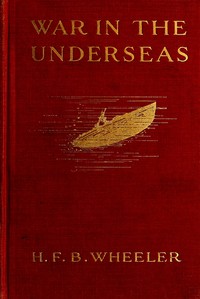
For War in the Underseas — Inside the Classic, the stored edition analysis reports 60,361 words, 4 hr 23 min estimated reading time, and 21 detected text sections.
The text analysis averages about 19.2 words per sentence, while the detected sections provide another way to judge how the source is divided.
Project Gutenberg metadata also associates the work with “World War, 1914-1918 -- Naval operations -- Submarine,” connecting these edition facts with the source record’s subject description.
Explore this collection
These alternatives are selected using recorded categories and estimated reading time.
About 263 minutes
World Events
60,321 recorded words. 0 minutes difference from this book's estimate.
View Gutenberg source #64633About 263 minutes
World Events
60,329 recorded words. 0 minutes difference from this book's estimate.
View Gutenberg source #75745About 256 minutes
World Events
58,696 recorded words. 7 minutes difference from this book's estimate.
View Gutenberg source #75744Search stored excerpts and compare books → Choose by your preferences →
Choices use stored catalog measurements. Estimates vary with reading speed. A shared category is a catalog label, not a claim that two books have the same argument or literary quality.
Search reads excerpt text stored with this catalog and links to its associated Gutenberg record. The connection is stored in the site database; this tool does not recheck that every excerpt is word-for-word identical to that external record. Excerpt search does not cover every chapter and does not verify historical publication dates.
Catalog snapshot checked: 2026-09-25. Coverage: 97 public books, 97 available source excerpts.
Calculated from edition completeness, EPUB availability, text structure and catalogue metadata. Not a user rating.
Total of 100 points, scaled to a 2.5-5.0 range. Editions with an empty description or a missing EPUB file are not scored.
Public-domain source text
The source text is kept in the dedicated reader, separate from this catalogue record and its commentary.
Harold Wheeler opens War in the Underseas with a foreword that frames the British submarine campaign as a perilous and noble part of the Great Conflict, immediately establishing a tone of patriotic resolve. The narrative voice is direct and occasionally dramatic, describing how British submarines poked their inquisitive noses into the Heligoland Bight hours after war was declared. Wheeler’s prose shifts between sweeping strategic statements and tight, action-focused episodes, such as the account of a U-boat opening fire on the Danish steamer Odense and the sudden appearance of a British submarine summoned by aircraft. The language is vivid but factual, with a clear emphasis on the technical challenges and dangers of undersea warfare.
Wheeler’s authorial voice is that of a historian with a flair for the dramatic. He uses personification and metaphor to animate naval vessels: British submarines are described as having inquisitive noses, while a U-boat is called a pirate. The foreword’s dedication to Geoffrey Charles Taskar Keyes expresses a hope that he may emulate his father’s daring at Zeebrugge and Ostend, linking the book to contemporary heroism. Wheeler also employs rhetorical contrasts—such as the British Navy being neither spiteful nor cruel compared to German actions—to reinforce a moral framework. These stylistic choices give the narrative a purposeful, almost propagandistic energy, though they are grounded in specific operational details.
The excerpts reveal a deliberate variation in pace. Wheeler often begins a section with a calm, almost mundane observation—such as a seaplane pilot finding his patrol a trifle boring without action—before accelerating into a sudden engagement. The attack on a U-boat by a blimp is narrated with step-by-step precision: the bomb falling three feet short, oil spurting to the surface, then a direct hit aft of the conning-tower. This rhythm of lull and crisis mirrors the actual experience of naval patrols, where long stretches of vigilance are punctuated by moments of intense action. Wheeler’s sentences grow shorter and more urgent during combat, creating a sense of immediacy.
Wheeler repeatedly notes the interplay between different branches of naval warfare: submarines, airships, seaplanes, and surface patrols. He describes how a British coastal airship altered course to traverse the trail of a torpedo, traveling at a rate approaching ninety miles an hour. Technical details—such as ballast tanks filling slowly, or bombs exploding astern of propellers—anchor the narrative in practical realities. Wheeler also highlights the fallibility of perception: presumed periscopes are sometimes nothing more than mops or spars. These observations ground the heroic tone in the mundane challenges of naval operations, from breakdowns to the difficulty of spotting submerged U-boats.
Readers approaching War in the Underseas should attend to Wheeler’s careful construction of suspense and his use of technical detail to lend authenticity. The book rewards those interested in the operational realities of WWI submarine warfare, but its patriotic framing and occasional moralizing reflect the context of 1918. For a fuller understanding, compare Wheeler’s accounts with official naval histories or later scholarly analyses of the U-boat campaign.
Reading Wheeler’s cramped patrols, I remembered my grandfather’s silence about the Somme. Strange, how war’s mechanics—his tunnels, their torpedoes—leave such hollow echoes in those who return. That same weight filled the pages of On the Anzac trail: Being extracts from the diary of a New Zealand sapper — Reading Notes, another quiet voice from beneath the roar.
Use these questions to collect your thoughts before moving on.