1

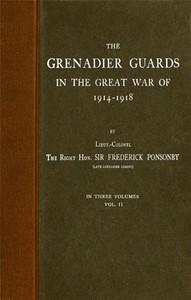
The Grenadier Guards in the Great War of 1914-1918, Vol. 2 of 3 — Story, Setting & Ideas
(0 User reviews)
1495
Project Gutenberg
2020
Not confirmed
World War, 1914-1918 -- Regimental histories -- Great Britain; Great Britain. Army. Grenadier Guards
Readers of public-domain and historical texts
Project Gutenberg digital edition
en
Edition facts
Words
102,177
Reading time
445 min
Text sections
22
For The Grenadier Guards in the Great War of 1914-1918, Vol. 2 of 3 — Story, Setting & Ideas, the stored edition analysis reports 102,177 words, 7 hr 25 min estimated reading time, and 22 detected text sections.
The text analysis averages about 18.3 words per sentence, while the detected sections provide another way to judge how the source is divided.
Project Gutenberg metadata also associates the work with “World War, 1914-1918 -- Regimental histories -- Great Britain,” connecting these edition facts with the source record’s subject description.
Source:
Project Gutenberg record #61216
Frederick Ponsonby's regimental history of the Grenadier Guards in 1916-1918 details battalion-level operations through precise orders of battle, raid rehearsals, and the tension between ceremonial tradition and industrial warfare.
Editorial Edition Score
4.9/5
★★★★★
★★★★★
Calculated from edition completeness, EPUB availability, text structure and catalogue metadata. Not a user rating.
How this score is calculated
- Description quality20 pts
- Title & short description10 pts
- Source metadata20 pts
- Text length15 pts
- Chapters / structure15 pts
- EPUB file integrity20 pts
Total of 100 points, scaled to a 2.5-5.0 range. Editions with an empty description or a missing EPUB file are not scored.
Edition quality
Public-domain source text
Read the source text
The source text is kept in the dedicated reader, separate from this catalogue record and its commentary.
Frederick Ponsonby's account of the Grenadier Guards from 1916 to 1918 is built around battalion-level orders of battle and daily operational logs. The text repeatedly lists officers by name and company, as in the 4th Battalion's roster for July 1917, where Lieut. R. G. West, 2nd Lieut. T. T. Pryce, and others are assigned to No. 1 Company. This meticulous naming creates a ledger-like record of personnel, contrasting with the impersonal scale of the war.
The narrative also records the regiment's efforts to maintain unit cohesion through events like the second anniversary of the 4th Battalion's formation, celebrated with a football match, tug-of-war, and free beer. Such details reveal a deliberate preservation of regimental identity amid the constant churn of casualties and fatigue parties.
Rehearsal and Raid: The Mechanics of Attack
The excerpt describing the 4th Battalion's raid on the Boesinghe sector in July 1917 illustrates Ponsonby's focus on procedure. The raid was rehearsed for three days so that 'every man knew exactly what to do.' This emphasis on preparation reflects the Guards' professional ethos, yet the execution reveals friction: a mat provided to cross the mud proved too short, forcing men to plunge into a canal. The narrative records both the plan and its breakdown, including a raider who 'lost his head.' Ponsonby does not moralize; he simply notes the deviation from the rehearsed script.
Such passages show how the history functions as a technical after-action report, documenting what worked and what did not. The raid's mixed outcome—penetrating the German line in four places but encountering a double sentry post—is presented without embellishment, leaving the reader to infer the chaos behind the orderly prose.
Fatigue, Shelling, and the Daily Grind
Between set-piece battles, the Guards endured a relentless cycle of fatigue parties and shelling. In early July 1917, the 4th Battalion had to find 500 to 600 men daily for work in the forward area. The camp, 'well within the range of the German shells,' was hit repeatedly, though casualties were luckily absent. Ponsonby records these events with the same flat tone he uses for combat, implying that danger was routine.
The text also notes gas alarms and the order to sleep with helmets in the 'alert' position. These small details accumulate to show a unit constantly on edge, yet still finding time for a battalion concert and a sergeants' dinner attended by the Corps Commander. The juxtaposition of mortal risk and ceremonial morale-building is a recurring pattern in Ponsonby's account.
The Limits of the Regimental Lens
Ponsonby's history is deliberately narrow, focusing on the Grenadier Guards' internal structure and movements. The excerpt gives no strategic overview of the Somme or Third Ypres; instead, it traces the 4th Battalion's path from camp to front line, naming officers and recording the number of men for fatigues. This micro-level view is both a strength and a limitation. It preserves the texture of battalion life—the football match, the too-short mat—but offers little context for why these actions mattered in the larger war.
Readers seeking a broader operational history will need to supplement this volume with other sources. Ponsonby assumes familiarity with the campaign's outline; his contribution is the granular record of one regiment's experience, told through the names and routines that official histories often omit.
Ponsonby's volume rewards readers who attend to its lists and repetitions. The repeated naming of officers, the tally of fatigue parties, and the careful notation of rehearsals all build a portrait of a regiment trying to impose order on chaos. This is not a dramatic narrative but a documentary one, best read in conjunction with maps and a timeline of the Western Front. The gaps in the text—what is left unsaid about fear, loss, or strategy—are as instructive as what is recorded.
Sometimes I think about Ponsonby's Grenadiers—men who rehearsed raids like drills for the parade ground, then walked into industrial slaughter. It stayed with me, that quiet tension between ceremony and survival. Your friend lent me Under the German shells — Background and Themes afterwards, and it felt like a hand on my shoulder, saying yes, I saw that too.
There are no reviews for this eBook.
There are no comments for this eBook.
Reader reflection
How will you remember this book?
Save your reaction, strongest insight, and memorable passage.
Your progress
0
/
10
2
Did this book hold your interest?
3
Is this a title you would suggest to others?
4
How demanding did the text feel?
5
How strong was your personal connection to the text?
6
Which part made the strongest impression?
7
How useful were the ideas in this book?
8
How distinctive were its ideas or approach?
9
Which lesson or insight stayed with you?
10