About 152 minutes
The Jews in the Eastern War Zone — Context and Discussion
World Events
34,887 recorded words. 18 minutes difference from this book's estimate.
View Gutenberg source #62816
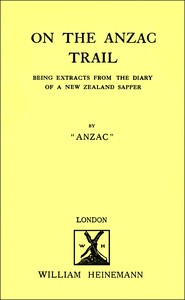
On the Anzac trail: Being extracts from the diary of a New Zealand sapper — Reading Notes can be approached with a clearer sense of reading commitment from its source measurements: 38,900 words, 2 hr 50 min estimated reading time, and 13 detected text sections.
The text analysis averages about 18.8 words per sentence, while the detected sections provide another way to judge how the source is divided.
Project Gutenberg metadata also associates the work with “World War, 1914-1918 -- Personal narratives, New Zealand,” connecting these edition facts with the source record’s subject description.
Explore this collection
These alternatives are selected using recorded categories and estimated reading time.
About 152 minutes
World Events
34,887 recorded words. 18 minutes difference from this book's estimate.
View Gutenberg source #62816About 149 minutes
World Events
34,130 recorded words. 21 minutes difference from this book's estimate.
View Gutenberg source #66363About 148 minutes
World Events
33,871 recorded words. 22 minutes difference from this book's estimate.
View Gutenberg source #56323Search stored excerpts and compare books → Choose by your preferences →
Choices use stored catalog measurements. Estimates vary with reading speed. A shared category is a catalog label, not a claim that two books have the same argument or literary quality.
Search reads excerpt text stored with this catalog and links to its associated Gutenberg record. The connection is stored in the site database; this tool does not recheck that every excerpt is word-for-word identical to that external record. Excerpt search does not cover every chapter and does not verify historical publication dates.
Catalog snapshot checked: 2026-09-25. Coverage: 97 public books, 97 available source excerpts.
Calculated from edition completeness, EPUB availability, text structure and catalogue metadata. Not a user rating.
Total of 100 points, scaled to a 2.5-5.0 range. Editions with an empty description or a missing EPUB file are not scored.
Public-domain source text
The source text is kept in the dedicated reader, separate from this catalogue record and its commentary.
The diary opens not in New Zealand but in Ireland, where the author, a veteran of the South African campaign, reads a call for New Zealanders to enlist. He signs up in London, and the voice is established at once: colloquial, sardonic, and self-deprecating. He describes the impulse to fight as something 'in the Britisher's blood,' comparing war to football or a round-up. This framing—a colonial soldier who left New Zealand years before—gives the narrative a particular distance and a sense of the Empire's reach.
The early chapters move quickly from recruitment to training in Egypt, where the author observes the local scene with a mixture of amusement and impatience. The diary form allows for abrupt shifts between mundane details and grim anticipation, a rhythm that will define the book.
The author writes as 'a man in the ranks,' and his language is consistently that of a soldier, not an officer. He uses slang ('roll up,' 'slather-up'), calls the Turks 'the enemy' without demonization, and refers to his comrades as 'the chaps.' The dedication page includes a Maori war cry—Komate! Komate!—which he translates simply as 'Which is also true.' This blend of irreverence and respect for the men beside him is a thread throughout the excerpts.
He does not claim heroism. Before the landing, he notes that the staff expected 80 percent casualties, and the soldiers respond by making bets and tossing coins to guess who will die. The tone is matter-of-fact: 'No one the least downhearted; all determined to at least give the enemy the time of his life.' The diary records fear without melodrama, and the author’s own role as a sapper—a military engineer—is mentioned only in the subtitle.
The entry for April 28 is the first chance to write after three days. The author calls it 'hell—just that' and 'cold-blooded butchery.' The description of the approach is vivid but controlled: the boats creep in darkness, the cliffs loom, the warships are 'like couchant lions scenting blood.' He notes the stillness, the lack of lights, the uncertainty—'Could it be that we had taken the Turks by surprise? Or were they simply lying low?'
Once ashore, the diary becomes fragmentary. The landing itself is not described in detail; instead, the aftermath is a blur of survival. The author admits he cannot fully convey what happened: 'How the position has been held beats me.' This restraint is typical of the diary form—events are recorded as they are processed, not as a polished narrative.
Later excerpts show the daily grind of the trenches. The author’s humor persists: he refers to the fighting as 'our amusement' and notes that the men were issued tobacco and cigarettes before going ashore. The contrast between the official briefing—three days on a pint and a half of water—and the soldiers’ black jokes ('tossing up to see if certain of their mates will finish up in heaven or hell') is a recurring pattern.
The diary also records small details that ground the experience: the weather is 'A1,' the sea calm; the men hand in their blankets, knowing they will not return for them. The author’s focus is on what is immediate and physical—the weight of a water bottle, the taste of biscuits—rather than on strategy or politics. This narrow lens gives the account its authenticity.
The table of contents lists ten chapters, from 'Joining up' to 'The Order of the Push,' suggesting a chronological arc from enlistment to the end of the author’s service. The excerpts provided cover only the opening and the landing; the middle chapters—'Life in Egypt,' 'Day by Day,' 'At Grips'—are not included. Based on the available text, the diary appears to move from preparation to combat to the prolonged stalemate of the trenches.
The author’s perspective is that of a New Zealander who has lived abroad, which may color his observations of both the British and the Turkish forces. The diary’s title, On the Anzac Trail, and the pseudonym 'Anzac' emphasize the collective identity of the Australian and New Zealand Army Corps, but the narrative is distinctly individual.
Readers should approach this diary as a fragmentary record, not a comprehensive history. The author’s voice is consistent—blunt, occasionally profane, and often wry—but the gaps in the excerpts mean that the full arc of his experience is only hinted at. Pay attention to the small details: the tobacco ration, the bets among the men, the way the landscape is described. These are the elements that distinguish this account from official reports or later memoirs.
I keep thinking about that sapper’s diary—how the grind just goes on, and humour becomes the only soft place to land. It made me remember a quieter companion, The Ways of War — A Reader’s Guide, which sits beside those raw entries like a long exhale. Some books don’t leave you; they just wait until you’re ready to understand them.
Capture what you thought, learned, and would like to remember.