1

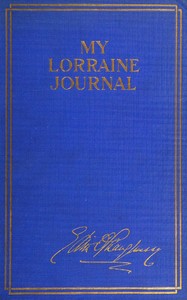
My Lorraine journal — Reading Companion
(0 User reviews)
1314
Project Gutenberg
2025
Not confirmed
World War, 1914-1918 -- Personal narratives
Readers of public-domain and historical texts
Project Gutenberg digital edition
en
Edition facts
Words
58,696
Reading time
256 min
Text sections
27
For My Lorraine journal — Reading Companion, the stored edition analysis reports 58,696 words, 4 hr 16 min estimated reading time, and 27 detected text sections.
The text analysis averages about 22.9 words per sentence, while the detected sections provide another way to judge how the source is divided.
Project Gutenberg metadata also associates the work with “World War, 1914-1918 -- Personal narratives,” connecting these edition facts with the source record’s subject description.
Source:
Project Gutenberg record #75744
Edith O'Shaughnessy's journal records her experiences in Lorraine during World War I, blending observations of war-torn landscapes with reflections on the women serving on the home front and the region's layered history.
Editorial Edition Score
4.9/5
★★★★★
★★★★★
Calculated from edition completeness, EPUB availability, text structure and catalogue metadata. Not a user rating.
How this score is calculated
- Description quality20 pts
- Title & short description10 pts
- Source metadata20 pts
- Text length15 pts
- Chapters / structure15 pts
- EPUB file integrity20 pts
Total of 100 points, scaled to a 2.5-5.0 range. Editions with an empty description or a missing EPUB file are not scored.
Edition quality
Public-domain source text
Read the source text
The source text is kept in the dedicated reader, separate from this catalogue record and its commentary.
Edith O'Shaughnessy opens her journal with a frank admission that the writing was 'fortuitous though inevitable,' begun before American troops arrived in France. Her account is anchored in Lorraine, a region she presents as both a war zone and a repository of centuries—evident in her description of eighteenth-century fire-backs and the arms of Maria Theresa. The journal does not attempt a comprehensive war history; instead, it offers a personal, episodic record of what she sees and whom she meets.
Women in the War's 'Lining'
O'Shaughnessy devotes notable attention to the women she encounters, particularly those she calls 'the unchosen and unmated.' In one passage, she describes two Englishwomen emerging from a hospital—one nearing sixty with 'banked fires' in her eyes, the other in the grip of 'l'âge dangereux.' She reflects that the war has brought such women, for the first time, into sustained contact with men outside their families, making them 'part of the strange lining of the war, part of the vast patchwork.' Her language is precise: she sees them as 'pale, thin bits, sewn into something riotous, reckless, multicolored, heroic.' This is not a general tribute to women's war work but a specific, almost anthropological observation of a social transformation.
Objects and Their Histories
Throughout the journal, O'Shaughnessy pauses on material artifacts that carry layered meanings. In one scene, she examines fire-backs—iron plaques placed behind hearths—noting their origins: 'l'amour désarmé' from the eighteenth century, a Louis XVI piece depicting a housewife, and a Crimean War scene that could be 'any one of a hundred thousand scenes of to-day.' She traces their provenance to the King of Spain and Maria Theresa, remarking that their origins were 'as diverse as the history of Lorraine itself.' These objects anchor her observations in tangible history, contrasting the permanence of metal with the transience of war.
The Gardener and the White Dust
A particularly striking episode involves a soldier-gardener sent to tidy her garden. O'Shaughnessy notices 'such a passion of tenderness in the way he handled his rake' that she speaks with him. He is from Cette, a territorial assigned to the 'État-Civil des Champs de Bataille'—civilian workers on battlefields. For eighteen months, a man who 'all his life has planted flowers' has been 'digging up dead bodies, hunting in a literal “body of death” to find the plaques.' The contrast between his former life and his current duty is stark. Meanwhile, she notes the heat: 'Out there in the Champagne Pouilleuse men are marching in the white dust, resting in the white dust, giving up their lives in the white dust.' The repetition of 'white dust' becomes a refrain for the war's erasure.
O'Shaughnessy's journal resists easy categorization. It is neither a frontline report nor a home-front memoir, but a hybrid that moves between the Ducal Palace in Nancy and the gardens of Vitrimont. Readers should attend to her eye for detail—the fire-backs, the gardener's rake, the 'white dust'—as clues to her method. She writes as a diplomat's wife, an outsider with access, and her observations are filtered through a sensibility attuned to the 'eternal reasons in transient things.'
I often think of Edith O'Shaughnessy’s Lorraine journal, her careful hand noting the quiet courage of women amid the rubble. It shares a hushed kinship with With our army in Flanders — A Closer Reading, as both hold the same patient sorrow—war’s landscape remembered not in headlines, but in the steady, unbroken witness of those who remained.
There are no reviews for this eBook.
There are no comments for this eBook.
Reader reflection
What was your reading experience?
Capture what you thought, learned, and would like to remember.
Your progress
0
/
10
2
Was reading this book enjoyable?
3
Would you encourage someone else to read it?
4
How demanding did the text feel?
5
Was the book easy to understand?
6
How did the pace of the book feel?
7
How strong was your personal connection to the text?
8
How would you rate its originality?
9
What changed or sharpened your thinking?
10