1

Two war years in Constantinople — Inside the Classic
(0 User reviews)
646
Project Gutenberg
2019
Not confirmed
World War, 1914-1918 -- Turkey
Readers of public-domain and historical texts
Project Gutenberg digital edition
en
Edition facts
Words
55,918
Reading time
244 min
Text sections
5
Before opening Two war years in Constantinople — Inside the Classic, the edition data offers a quick orientation: 55,918 words, 4 hr 4 min estimated reading time, and 5 detected text sections.
The text analysis averages about 36.8 words per sentence, while the detected sections provide another way to judge how the source is divided.
Project Gutenberg metadata also associates the work with “World War, 1914-1918 -- Turkey,” connecting these edition facts with the source record’s subject description.
Source:
Project Gutenberg record #60638
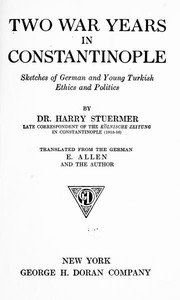
A German journalist's firsthand account of wartime Constantinople in 1915-16, focusing on tensions between German and Young Turk policies, language decrees, and nationalist measures, based on his observations as a correspondent.
Editorial Edition Score
4.7/5
★★★★★
★★★★★
Calculated from edition completeness, EPUB availability, text structure and catalogue metadata. Not a user rating.
How this score is calculated
- Description quality20 pts
- Title & short description10 pts
- Source metadata20 pts
- Text length15 pts
- Chapters / structure15 pts
- EPUB file integrity20 pts
Total of 100 points, scaled to a 2.5-5.0 range. Editions with an empty description or a missing EPUB file are not scored.
Edition quality
Public-domain source text
Read the source text
The source text is kept in the dedicated reader, separate from this catalogue record and its commentary.
Dr. Harry Stuermer, a German correspondent for the Kölnische Zeitung stationed in Constantinople from 1915 to 1916, offers a critical insider's view of the German-Turkish alliance during World War I. His account, originally published in 1917, is framed by a sworn declaration that he wrote without outside influence, motivated solely by conscience. The excerpts reveal a sharp focus on the Young Turk government's efforts to Turkify commercial and public life, including language decrees that required German businesses to use Turkish in bookkeeping and correspondence. Stuermer notes the irony of German officials and professors being compelled to wear the fez and learn Turkish within a year, while Greek signs were removed only after German ones had disappeared. This editorial note examines how the catalog subject—World War, 1914-1918—Turkey—aligns with the actual content, which emphasizes inter-allied friction and nationalist policies rather than military events.
The Author's Position and Purpose
Stuermer's preface and declaration establish his unusual stance: a German publicly criticizing his own government and its ally. He claims to act on conscience, having avoided contact with anyone in Switzerland until his manuscript was sent to press. The excerpts show he was a former correspondent, not a diplomat or soldier, and his observations are explicitly labeled as sketches of ethics and politics. The catalog subject broadly covers the war in Turkey, but Stuermer's focus is on internal dynamics—German arrogance, Turkish nationalism, and the failure of cooperation. He describes pan-German expansionists celebrating Turkish alliance, only to be countered by decrees forcing German signs to be replaced by Turkish. This tension, not combat, dominates the text.
Language as a Battleground
A recurring detail is the struggle over language. Stuermer reports that Talaat's decree required all German notices to disappear, and later Greek signs were also removed. Turkish became mandatory for bookkeeping in banks and newspapers, threatening German employees who faced learning Turkish or losing their jobs. Stuermer calls this a 'sword of Damocles' over German businesses. He notes that the 'Osmanic Lloyd' and the 'German Bank' would have to keep Turkish books for a European clientele. These specific examples ground the narrative in administrative reality, showing how nationalist policies directly affected daily operations. The catalog subject does not capture this granular conflict over language and commerce.
German Optimism vs. Turkish Realities
Stuermer contrasts German optimism—belief in a final Turkish victory—with the Young Turks' systematic Turkification. He mentions German officials 'foisted on the Turkish Government' and professors who had to wear the fez and learn Turkish, yet still provoked anti-German comment. The excerpts suggest that by summer 1916, even blind optimists began to see that Germany would have no place in a victorious Turkey. Stuermer's tone is critical of both sides: German overconfidence and Turkish nationalism. The catalog subject implies a military history, but the text is a political commentary on alliance friction, with no battle scenes or strategic analysis in the provided excerpts.
Readers should approach Two War Years in Constantinople as a polemical memoir rather than a comprehensive history. Stuermer's evidence is anecdotal and shaped by his personal mission to expose German and Turkish failings. The excerpts offer a vivid, if partial, picture of wartime bureaucracy and cultural conflict. For a fuller understanding, consider how his position as a German critic may color his portrayal of Turkish policies and German responses.
Reading that correspondent's quiet anguish over language decrees in old Constantinople, I thought of something else sitting on my shelf. It’s the Historical records of the Buffs, East Kent Regiment (3rd Foot) — A Reader’s Guide, and how those soldiers’ names felt like a similar kind of witness. Both left me with a strange, heavy tenderness for people caught in other people's politics.
There are no reviews for this eBook.
There are no comments for this eBook.
Reader reflection
How did this book work for you?
Your answers remain private and are stored only in this browser.
Your progress
0
/
10
2
What was your overall reaction to the book?
3
How likely are you to recommend this book?
4
What was the reading difficulty like?
5
Would this book work well in a reading group?
6
Could you see yourself revisiting this book?
7
What did you appreciate most?
8
Did this book create an emotional response?
9
What is the main idea you are taking away?
10