1

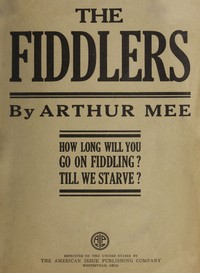
The Fiddlers; Drink in the Witness Box — Reading Notes
(0 User reviews)
537
Project Gutenberg
2016
Not confirmed
World War, 1914-1918; Alcoholism
Readers of public-domain and historical texts
Project Gutenberg digital edition
en
Edition facts
Words
25,045
Reading time
109 min
Text sections
23
The catalog record for The Fiddlers; Drink in the Witness Box — Reading Notes provides practical reading context through 25,045 words, 1 hr 49 min estimated reading time, and 23 detected text sections.
The text analysis averages about 23.1 words per sentence, while the detected sections provide another way to judge how the source is divided.
Project Gutenberg metadata also associates the work with “World War, 1914-1918,” connecting these edition facts with the source record’s subject description.
Source:
Project Gutenberg record #53733
Arthur Mee's 1917 polemic uses courtroom metaphor and documentary evidence to argue that the British drink trade undermined the war effort, causing famine, shell shortages, and moral decay. The text shifts between fiery rhetoric and dry police-court records, creating a layered indictment.
Editorial Edition Score
4.8/5
★★★★★
★★★★★
Calculated from edition completeness, EPUB availability, text structure and catalogue metadata. Not a user rating.
How this score is calculated
- Description quality20 pts
- Title & short description10 pts
- Source metadata20 pts
- Text length15 pts
- Chapters / structure15 pts
- EPUB file integrity20 pts
Total of 100 points, scaled to a 2.5-5.0 range. Editions with an empty description or a missing EPUB file are not scored.
Edition quality
Public-domain source text
Read the source text
The source text is kept in the dedicated reader, separate from this catalogue record and its commentary.
Arthur Mee opens The Fiddlers; Drink in the Witness Box with a biblical epigraph—“If thou forbear to deliver them that are drawn unto death”—and immediately casts the drink trade as a traitor within Britain’s gates. The book’s title itself sets up a courtroom: the drink trade is the accused, and Mee calls witness after witness from police records, coroners’ inquests, and parliamentary returns. The narrative voice alternates between prophetic denunciation and the flat, factual tone of official documents. A typical passage moves from Mee’s own indictment—“they play and palter with the greatest enemy force outside Berlin”—to a verbatim police report: “A sapper seaman was found dead at the quay. Another seaman said his friend had seven drinks.” This juxtaposition of moral outrage and bureaucratic detail gives the book its peculiar force.
Prophetic Fury and Statistical Calm
Mee’s own prose is deliberately biblical in cadence. He speaks of “eternal glory or eternal shame,” of rulers who “quail before a foe within the gate.” The repetition of “she has let” in a single paragraph—five times in quick succession—builds a rhythm of accusation. Yet these rhetorical crescendos are immediately followed by numbered facts: “4,800,000 tons of food” destroyed, “£1,000,000 a week” paid to the government. The effect is that of a sermon punctuated by exhibits. Mee does not argue so much as present evidence and then hammer it home with moral language. The reader is never allowed to settle into either pure emotion or pure data; the two modes constantly interrupt each other, creating a sense of urgency and irrefutability.
The Witnesses: Voices from the Dock
The excerpts include a dozen or more short testimonies from police courts, inquests, and assizes. These are not summarized but quoted directly, often with the source line: “Police Records of Southport, January 9, 1915” or “Facts in ‘Western Daily Mercury,’ January 8, 1917.” The voices are varied: a disabled soldier who plans to spend his pension on “a month’s booze”; a lieutenant who calls drink “the whole trouble”; a coroner who declares prohibition “a blessing.” Mee lets these speakers contradict or reinforce each other. The soldier’s casual confession sits alongside the judge’s solemn warning about “millions of brave men” returning to temptation. By refusing to smooth these voices into a single narrative, Mee creates a mosaic of social breakdown—each fragment a small, damning story.
Pace and Accumulation: The Weight of Repetition
The book’s structure is cumulative. Mee does not develop a linear argument but piles instance upon instance. The same phrases recur: “the foe within the gate,” “the greatest enemy force outside Berlin,” “the drink trade.” Each new witness adds weight without advancing a thesis. The pace is relentless—short paragraphs, frequent source citations, and a refrain of “there is no room for them here” that paradoxically makes room for more. The effect is that of a drumbeat. By the time the reader reaches the Derbyshire Assizes record of a decorated soldier ruined by drink, the pattern is familiar: a good man, a few drinks, a fall. Mee’s method is not persuasion but accumulation; he means to overwhelm.
Readers should attend to the tension between Mee’s prophetic voice and the documentary evidence he marshals. The book is not a history but a polemic built from fragments. Pay attention to the sources he chooses—police records, newspaper clippings, parliamentary returns—and how he frames them. The gaps are as telling as the inclusions: what voices are missing? The book’s power lies in its relentless specificity, but that same specificity limits its scope. It is a wartime document, not a balanced inquiry.
I keep thinking about that old war-time book, how the dry court records felt heavier than the anger around them. It left a quiet ache, that sense of ordinary lives caught in something vast. I found a similar weight later in Told in gallant deeds — Reading Notes, though its light is gentler. Different shadows, same hush.
There are no reviews for this eBook.
There are no comments for this eBook.
Reader reflection
What did you think of this book?
Answer a few questions and save a private reflection on this device.
Your progress
0
/
10
2
Was reading this book enjoyable?
3
Would you encourage someone else to read it?
4
How demanding did the text feel?
5
What did you appreciate most?
6
Would you like to discuss this book with someone?
7
Did anything about the book feel genuinely new?
8
Would you read this book again?
9
What changed or sharpened your thinking?
10