1

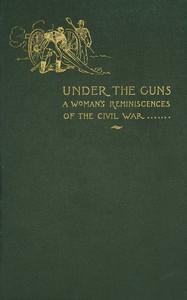
Under the guns — Context and Discussion
(0 User reviews)
1592
Project Gutenberg
2024
Not confirmed
United States -- History -- Civil War, 1861-1865 -- Personal narratives
Readers of public-domain and historical texts
Project Gutenberg digital edition
en
Edition facts
Words
60,620
Reading time
264 min
Text sections
71
Before opening Under the guns — Context and Discussion, the edition data offers a quick orientation: 60,620 words, 4 hr 24 min estimated reading time, and 71 detected text sections.
The text analysis averages about 18.9 words per sentence, while the detected sections provide another way to judge how the source is divided.
Project Gutenberg metadata also associates the work with “United States -- History -- Civil War, 1861-1865 -- Personal narratives,” connecting these edition facts with the source record’s subject description.
Source:
Project Gutenberg record #73190
Annie Wittenmyer's firsthand account of nursing Union soldiers under fire during the Civil War, from Keokuk hospitals to the siege of Vicksburg, with a preface disclaiming military history and focusing on personal incidents and 'heart histories.'
Editorial Edition Score
4.8/5
★★★★★
★★★★★
Calculated from edition completeness, EPUB availability, text structure and catalogue metadata. Not a user rating.
How this score is calculated
- Description quality20 pts
- Title & short description10 pts
- Source metadata20 pts
- Text length15 pts
- Chapters / structure15 pts
- EPUB file integrity20 pts
Total of 100 points, scaled to a 2.5-5.0 range. Editions with an empty description or a missing EPUB file are not scored.
Edition quality
Public-domain source text
Read the source text
The source text is kept in the dedicated reader, separate from this catalogue record and its commentary.
Annie Wittenmyer opens her reminiscences with a clear disclaimer: she will not attempt to record military movements as history, but rather to bring out 'a few of the many incidents and heart histories' crowded into her life from April 1861 to November 1865. The preface establishes a plain, unembellished voice—'told just as they occurred, without any attempt at literary embellishment'—that carries through the narrative. The dedication to army nurses and Iowa women signals the dual focus: the author's own work and the collective support behind her.
A Carriage Under Fire
One of the most striking episodes involves a silver-mounted carriage captured at Jackson, which Wittenmyer uses for hospital visits during the siege of Vicksburg. The carriage draws enemy fire because Confederates mistake it for a high-ranking officer's vehicle. A captain of sharpshooters later confesses that his men fired over a hundred shots at it, and the wheels are 'chipped till they were quite a curiosity.' The anecdote illustrates how the author's presence on the battlefield is both practical and perilous, and it reveals the ironic misperceptions of war. Wittenmyer reports the story with a mix of wry humor and understated horror, noting that the captain was 'very much shocked' to learn he had been shooting at a lady.
Learning to Live Under the Guns
When a shell bursts near her, Wittenmyer describes a visceral reaction: 'I could feel my flesh crawl in the most uncomfortable way, and every hair on my head seemed to stand upright.' The surgeon's blunt reply—'all the hospitals are under fire'—forces her to confront the reality that she must work daily under a 'rain of lead.' Her response is a shift in narrative pace: from shock to a night of prayer, then to a resolute courage. She writes, 'I seemed immortal; not a bullet had been moulded that could hit me.' This transformation is rendered in a compressed, almost breathless sequence, contrasting with the earlier detailed descriptions of the carriage and the shell burst.
Night and Day: The Sounds of Siege
Wittenmyer's account of life under siege includes sensory details that convey the constant threat. She describes shells with 'burning fuses' sailing up 'like stars of the first magnitude' and bursting into 'a shower of sparks and fragments, setting the heavens ablaze.' The language becomes almost lyrical, yet she immediately undercuts it with a practical observation: 'We became so accustomed to the horrid sounds of war that the absence or abatement of it would awaken us out of our sleep.' This rhythm—heightened description followed by matter-of-fact commentary—characterizes her narrative voice throughout the excerpts, balancing the extraordinary with the quotidian.
Lizards and Tents: Domestic Details
Amid the bombardment, Wittenmyer includes homely details that ground the narrative in a woman's perspective. She stays in a tent with Mrs. General Stone, where the feet of their cots are placed in jars of water to keep lizards away. She notes, 'We could hear their little feet scratching as they raced after each other over the tents.' The contrast between the grand spectacle of war and these small, intimate annoyances—'we women shrank from contact with anything so nearly akin to the serpent family'—adds texture to the memoir. These details also slow the pace, offering respite from the thunder of explosions before returning to the relentless battle.
Wittenmyer's narrative moves between the immediate, physical experience of war and a reflective, spiritual framework. Readers should attend to how she juxtaposes moments of terror with domestic routines, and how her voice shifts from plain reportage to heightened description. The preface's promise of 'heart histories' is fulfilled in these small, vivid scenes—the chipped carriage wheels, the scratching lizards, the sleepless nights when the guns fall silent.
I remember shelving Under the Guns years ago, Mrs. Wittenmyer's hand steady on the page, war’s raw heart-beat in her quiet words. It made me think of another stubborn soul, fighting for a lost cause, in Owen Glyndwr and the Last Struggle for Welsh Independence With a Brief Sketch of Welsh History — A Reader’s Guide. Both are testaments to fierce, quiet hope against the terrible weight of things.
There are no reviews for this eBook.
There are no comments for this eBook.
Reader reflection
Before you leave, reflect on the book
Use these questions to collect your thoughts before moving on.
Your progress
0
/
10
2
Did this book hold your interest?
3
How likely are you to recommend this book?
4
What was the reading difficulty like?
5
How clear did the writing feel?
6
Was the book moving at the right speed?
7
How would you rate its originality?
8
Was the book what you thought it would be?
9
In one sentence, what did you learn?
10




![Cover of Military Equipment [1917] — A Closer Reading](https://eqook.com/storage/media/covers/pg54213.jpg)