1

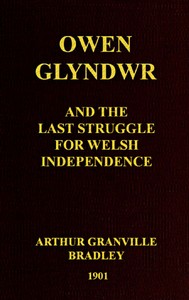
Owen Glyndwr and the Last Struggle for Welsh Independence With a Brief Sketch of Welsh History — A Reader’s Guide
(0 User reviews)
83
Project Gutenberg
2013
Not confirmed
Glendower, Owen, approximately 1354-1416; Revolutionaries -- Wales -- Biography; Nationalism -- Wales -- History; Princes -- Wales -- Biography; Wales -- History -- 1284-1536
Readers of public-domain and historical texts
Project Gutenberg digital edition
en
Edition facts
Words
102,116
Reading time
444 min
Text sections
15
The source record for Owen Glyndwr and the Last Struggle for Welsh Independence With a Brief Sketch of Welsh History — A Reader’s Guide measures this digital text at 102,116 words, 7 hr 24 min estimated reading time, and 15 detected text sections.
The text analysis averages about 28.7 words per sentence, while the detected sections provide another way to judge how the source is divided.
Project Gutenberg metadata also associates the work with “Glendower, Owen, approximately 1354-1416,” connecting these edition facts with the source record’s subject description.
Source:
Project Gutenberg record #42457
Bradley's 1901 biography of Owen Glyndwr examines the Welsh leader's rebellion through military campaigns, shifting alliances, and the political landscape of early 15th-century Britain, drawing on chronicles and letters to reconstruct a figure often obscured by legend.
Editorial Edition Score
4.9/5
★★★★★
★★★★★
Calculated from edition completeness, EPUB availability, text structure and catalogue metadata. Not a user rating.
How this score is calculated
- Description quality20 pts
- Title & short description10 pts
- Source metadata20 pts
- Text length15 pts
- Chapters / structure15 pts
- EPUB file integrity20 pts
Total of 100 points, scaled to a 2.5-5.0 range. Editions with an empty description or a missing EPUB file are not scored.
Edition quality
Public-domain source text
Read the source text
The source text is kept in the dedicated reader, separate from this catalogue record and its commentary.
Bradley opens his biography by acknowledging the scant personal details about Owen Glyndwr, noting that the hero 'lives in history rather by his deeds, and the deeds of those he leads and inspire.' The narrative moves briskly between battlefields and diplomatic maneuvers, as when the Battle of Homildon (1402) is shown to have 'exercised considerable influence upon the affairs of Owen' by souring relations between Henry IV and the Percy family. Bradley uses surviving documents—such as Mortimer's letter to his Radnor tenants, preserved in the British Museum—to anchor the story in verifiable evidence, while also recording legends 'for what they are worth' as illustrations of the period.
The Structure of Rebellion
The book is organized chronologically but frequently pauses to trace the shifting coalitions that defined Glyndwr's war. Bradley devotes careful attention to the interplay between Welsh and English factions, as when Mortimer's marriage to Glyndwr's daughter is described as 'of immense value' because it committed Mortimer's tenants and castles to the Welsh cause. The narrative moves from set-piece battles to the quieter work of siege and diplomacy, reflecting the fragmented nature of the conflict. Bradley also weaves in broader Welsh history, as the subtitle promises, but always returns to the central figure's campaigns.
Recurring Images of Landscape and Movement
Bradley frequently evokes the Welsh terrain—mountains, valleys, and passes—as both a refuge and a stage for guerrilla tactics. The frontispiece shows 'Glyndwr's Mount, Glyndyfrdwy,' grounding the hero in a specific place. The text describes armies sweeping through counties, as when the Scots 'swept through Northumberland and Durham almost unopposed,' or when Hotspur 'slipped round them' to block their retreat. These images of movement across contested ground reinforce the sense of a war fought over geography as much as loyalty.
The Use of Documentary Evidence
Bradley relies on chronicles like that of the 'monk of Evesham' and official letters to reconstruct events. He quotes Mortimer's French letter to his tenants, which states that Glyndwr's quarrel aims 'if King Richard be alive, to restore him to his crown; and if not that, my honoured nephew, who is the right heir to the said crown, shall be King of England.' Such documents allow Bradley to present the rebels' political rationale without speculation. He also notes where evidence is lacking, as when the location of Mortimer's wedding remains unknown, maintaining a careful distinction between fact and tradition.
The Percy-Glyndwr Nexus
Bradley traces how the Battle of Homildon and Henry IV's demand for the Scottish prisoners drove Hotspur into alliance with Glyndwr. The king's instructions that prisoners be handed over—'contrary to all custom and privilege'—are presented as the final straw for Percy, who was already 'sullen' over unpaid debts and Mortimer's captivity. This chain of cause and effect is typical of Bradley's method: he shows how a single battle's aftermath reshaped the entire political landscape, leading to the 'bloody field of Shrewsbury.' The narrative thus treats Glyndwr not in isolation but as a node in a network of grievances and ambitions.
Readers should approach Bradley's work as a product of its time—a turn-of-the-century biography that blends military history with national myth-making. The author's reliance on chronicles and letters gives the account a documentary feel, but his willingness to record legends reminds us that Glyndwr's story was already layered with interpretation. For those interested in the mechanics of medieval rebellion, the book offers a detailed case study in how a leader emerges from the gaps in the historical record.
I often think of Owen Glyndwr, that fierce flame of a lost cause, and then my gaze drifts to The history of the Twentieth (Light) Division — A Reader’s Guide. Both books whisper of men who endure when the larger story has already turned against them. Their battles are quiet echoes of courage, chronicled for those who seek the truth beneath the legend.
There are no reviews for this eBook.
There are no comments for this eBook.
Reader reflection
Before you leave, reflect on the book
Use these questions to collect your thoughts before moving on.
Your progress
0
/
10
2
How much did you enjoy the reading experience?
3
How likely are you to recommend this book?
4
How easy was the book to follow?
5
Could you follow the author’s main argument?
6
Was the book what you thought it would be?
7
Would you like to discuss this book with someone?
8
How original did the book feel?
9
In one sentence, what did you learn?
10


![Cover of Military Equipment [1917] — A Closer Reading](https://eqook.com/storage/media/covers/pg54213.jpg)