1

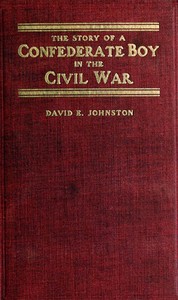
The Story of a Confederate Boy in the Civil War — Reading Companion
(0 User reviews)
75
Project Gutenberg
2014
Not confirmed
United States -- History -- Civil War, 1861-1865 -- Regimental histories; United States -- History -- Civil War, 1861-1865 -- Personal narratives, Confederate; Confederate States of America. Army. Virginia Infantry Regiment, 7th
Readers of public-domain and historical texts
Project Gutenberg digital edition
en
Edition facts
Words
69,226
Reading time
301 min
Text sections
8
The Story of a Confederate Boy in the Civil War — Reading Companion can be approached with a clearer sense of reading commitment from its source measurements: 69,226 words, 5 hr 1 min estimated reading time, and 8 detected text sections.
The text analysis averages about 21.0 words per sentence, while the detected sections provide another way to judge how the source is divided.
Project Gutenberg metadata also associates the work with “United States -- History -- Civil War, 1861-1865 -- Regimental histories,” connecting these edition facts with the source record’s subject description.
Source:
Project Gutenberg record #44889
David E. Johnston's 1914 memoir recounts his service in Company D, 7th Virginia Infantry, drawing on letters and memory. The narrative balances personal experience with company history, offering a rank-and-file perspective on the Civil War's campaigns and daily life.
Editorial Edition Score
4.7/5
★★★★★
★★★★★
Calculated from edition completeness, EPUB availability, text structure and catalogue metadata. Not a user rating.
How this score is calculated
- Description quality20 pts
- Title & short description10 pts
- Source metadata20 pts
- Text length15 pts
- Chapters / structure15 pts
- EPUB file integrity20 pts
Total of 100 points, scaled to a 2.5-5.0 range. Editions with an empty description or a missing EPUB file are not scored.
Edition quality
Public-domain source text
Read the source text
The source text is kept in the dedicated reader, separate from this catalogue record and its commentary.
David E. Johnston, a private in Company D, 7th Virginia Infantry, frames his 1914 memoir as a deliberate act of preservation. The preface explains that the book was rewritten at the request of surviving comrades, nearly fifty years after the war, and is based on letters he wrote during the conflict to a female friend—later his wife—who kept them. Johnston explicitly states his aim is to record the deeds of his company, not to offer a general history. This narrow focus shapes the narrative: the reader should expect a soldier's view of marches, camps, and battles, filtered through memory and a desire to honor fallen comrades.
A Company-Centered Narrative
Johnston dedicates the book to the surviving members of Company D, their widows, and the parents of those who died. He describes his bond with these men as “ties stronger than hooks of steel,” a phrase that signals the emotional core of the work. The narrative repeatedly returns to the company's actions, even in larger campaigns. For example, during the march toward Gettysburg, Johnston notes that James B. Croy of Company D was detailed as a cattle driver, a small detail that personalizes the army's movement. Readers should watch for how Johnston uses company-level anecdotes to ground the war's grand events in individual experience.
Memory and Its Sources
Johnston is candid about relying on memory after nearly half a century, but he also cites specific sources: letters written during the war and information from comrades. The preface mentions that his wife—the recipient of those letters—sits beside him as he writes in February 1914. This domestic detail underscores the memoir's dual nature as both a public record and a private reflection. The text occasionally shifts between immediate, letter-like observations and broader, retrospective commentary. For instance, Johnston recalls a dream during the march to Pennsylvania in which he saw his shoulder mangled by a cannon shot—a premonition that may or may not have come true, but which the reader can note as a marker of how memory and emotion shape the account.
The March into Pennsylvania: A Test of Loyalty
Johnston's description of the Confederate invasion of Pennsylvania in June 1863 reveals tensions within the ranks. He reports that many men disapproved of invading the North, having “uniformly insisted upon defensive warfare on our own soil.” Yet he adds that every soldier remained loyal to General Lee. The passage also notes the army's discipline: “no straggling, no desertion, no destruction of private property.” Johnston contrasts the prosperous Pennsylvania countryside with war-ravaged Virginia, observing that the locals seemed unaware of the conflict. At Chambersburg, ladies delivered a “sharp, spicy address” to which the regiment's band responded with “Dixie” and “Bonnie Blue Flag.” These details offer a nuanced view of morale and ideology among Confederate soldiers.
Everyday Realities and Ominous Signs
Interspersed with battle narratives are glimpses of camp life and its hardships. Johnston notes the execution of a deserter from the 18th Virginia regiment near Williamsport, Maryland—a stark reminder of military justice. He also records the destruction of the Cumberland Valley railroad by Pickett's division, describing how men heated rails and bent them around trees. Such passages ground the memoir in material details: the heat of the march, the work of tearing up tracks, the sight of beef cattle driven alongside the army. The dream of a mangled shoulder, mentioned earlier, hangs over these scenes, hinting at the violence to come. Readers should attend to these quieter moments, which reveal the texture of a soldier's life beyond the battlefield.
Johnston's memoir is best approached as a company history written by a participant, not a comprehensive account of the war. The excerpts show a writer balancing personal memory with a desire to document the actions of his comrades. Readers will benefit from noting the specific sources Johnston cites—letters, comrades' recollections—and from observing how he weaves small, company-level details into the larger narrative of campaigns. The preface's dedication to the fallen and their families sets a tone of reverence that colors every page.
Reading Johnston’s account of muddy marches and hardtack, I suddenly saw my grandfather’s old Bible, the one he carried through a war far away. He never spoke of it. What we don’t say stays loudest. Turning to Angels of the Battlefield A History of the Labors of the Catholic Sisterhoods in the Late Civil War — Reading Notes, I felt the same hush, the quiet work of women who also kept their own counsel.
There are no reviews for this eBook.
There are no comments for this eBook.
Reader reflection
How will you remember this book?
Save your reaction, strongest insight, and memorable passage.
Your progress
0
/
10
2
How did the book work for you overall?
3
Would you recommend this book to another reader?
4
Did the language feel accessible?
5
Could you see yourself revisiting this book?
6
Did this book create an emotional response?
7
How would you describe its reading pace?
8
How useful were the ideas in this book?
9
What changed or sharpened your thinking?
10


![Cover of Military Equipment [1917] — A Closer Reading](https://eqook.com/storage/media/covers/pg54213.jpg)