1

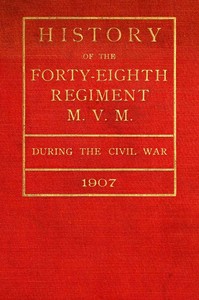
History of the Forty-Eighth Regiment M. V. M. During the Civil War — Edition Insights
(0 User reviews)
256
Project Gutenberg
2021
Not confirmed
United States -- History -- Civil War, 1861-1865 -- Regimental histories; Massachusetts -- History -- Civil War, 1861-1865 -- Regimental histories; United States. Army. Massachusetts Infantry Regiment, 48th (1862-1863)
Readers of public-domain and historical texts
Project Gutenberg digital edition
en
Edition facts
Words
34,777
Reading time
152 min
Text sections
11
The catalog record for History of the Forty-Eighth Regiment M. V. M. During the Civil War — Edition Insights provides practical reading context through 34,777 words, 2 hr 32 min estimated reading time, and 11 detected text sections.
The text analysis averages about 19.1 words per sentence, while the detected sections provide another way to judge how the source is divided.
Project Gutenberg metadata also associates the work with “United States -- History -- Civil War, 1861-1865 -- Regimental histories,” connecting these edition facts with the source record’s subject description.
Source:
Project Gutenberg record #66015
Albert Plummer's regimental history of the 48th Massachusetts Volunteers, structured as a diary from muster to discharge, with rosters and casualty details. The excerpts show a plain, factual narrative focused on the unit's service in Louisiana, including the assault on Port Hudson.
Editorial Edition Score
4.8/5
★★★★★
★★★★★
Calculated from edition completeness, EPUB availability, text structure and catalogue metadata. Not a user rating.
How this score is calculated
- Description quality20 pts
- Title & short description10 pts
- Source metadata20 pts
- Text length15 pts
- Chapters / structure15 pts
- EPUB file integrity20 pts
Total of 100 points, scaled to a 2.5-5.0 range. Editions with an empty description or a missing EPUB file are not scored.
Edition quality
Public-domain source text
Read the source text
The source text is kept in the dedicated reader, separate from this catalogue record and its commentary.
Albert Plummer announces in his preface that he has written the history of the 48th Massachusetts Volunteers in diary form, aiming for a "modest, true and valuable presentation of the main features of the services rendered." The opening chapter sets the national mood by describing the shock of Fort Sumter's fall and the subsequent call for troops. Plummer's voice is direct and unadorned, prioritizing factual sequence over dramatic flourish. The book includes extensive rosters of officers and enlisted men, with notes on enlistment, mustering, and casualties—such as Charles W. Poor, killed in the charge on Port Hudson on May 27, 1863. These lists anchor the narrative in individual names and fates.
Diary Structure and Chronological Frame
Plummer explicitly adopts a diary format, which shapes how the reader encounters the regiment's experience. The excerpts show entries that move from the initial outrage over Fort Sumter through the organization of the regiment in August and September 1862. The diary form imposes a day-by-day rhythm, but the surviving excerpts are incomplete; the full text likely includes gaps. Readers should note that Plummer does not claim to cover every incident—he acknowledges that more could have been written about individual companies. The chronology is the backbone, and the rosters serve as a reference for who served and when.
Rosters as a Window into the Regiment
The book devotes substantial space to company rosters, listing each soldier's name, hometown, enlistment date, muster date, and final status. For example, Company B includes Albert Plummer himself as 1st Sergeant, with his progression from sergeant to 1st sergeant on July 8, 1863. These rosters reveal patterns: most men enlisted in August and September 1862, mustered out on September 3, 1863, but a few died in service—like William F. Perkins, who died at the regimental hospital in Baton Rouge. The rosters also note transfers and desertions, such as Charles Walker, who deserted with "no further record." This data allows readers to trace individual trajectories within the unit's collective story.
Key Events: Port Hudson and Baton Rouge
The excerpts mention two critical locations: Port Hudson, Louisiana, and Baton Rouge. The regiment participated in the assault on Port Hudson on May 27, 1863, where Lieutenant-Colonel James O'Brien was killed and several enlisted men, including Charles W. Poor, died. The regimental hospital was at Baton Rouge, where William F. Perkins succumbed to illness. These details, drawn from the rosters and the narrative, indicate that the 48th Massachusetts saw combat and suffered losses in the Louisiana campaign. Readers should note that the excerpts do not provide a full account of the battle; the diary entries likely offer more context on the regiment's movements and engagements.
Plummer's Authorial Voice and Limitations
Plummer writes as a participant-historian, having served as 1st Sergeant in Company B. His preface thanks surviving comrades for assistance, including Lieutenant-Colonel Eben P. Stanwood. The tone is modest and collaborative, emphasizing a "true" record rather than a literary one. The excerpts show a preference for straightforward sentences and factual reporting. However, the text is not a complete battle history; Plummer acknowledges that many interesting particulars are omitted. Readers should approach the book as a primary source document—a veteran's compilation of official records and personal notes—rather than a polished narrative. The diary form may sometimes feel sparse, but it preserves the regiment's own chronology and priorities.
Plummer's history rewards readers who consult the rosters alongside the diary entries, as the names give human weight to the campaign timeline. The book is best read as a reference for the 48th Massachusetts' service, not as a standalone battle narrative. For those interested in the regiment's role at Port Hudson or the daily life of Massachusetts volunteers in Louisiana, the diary entries provide a skeleton that the rosters flesh out with individual stories of enlistment, survival, and loss.
I remember finding my grandfather’s old service diary, sparse entries about mud and waiting, and this regimental history felt similar—quiet names, careful dates, no grand words. It stirred something The Military Journals of Two Private Soldiers, 1758-1775 With Numerous Illustrative Notes — A Closer Reading once did, that same plain ache of ordinary men marking time before the unknown.
There are no reviews for this eBook.
There are no comments for this eBook.
Reader reflection
Record your reading impressions
A brief reflection can help important ideas stay with you longer.
Your progress
0
/
10
2
Did this book hold your interest?
3
Would you recommend this book to another reader?
4
Did the language feel accessible?
5
How useful were the ideas in this book?
6
Did you relate to its people, ideas, or situations?
7
Did the book offer a fresh perspective?
8
How well did it match your expectations?
9
What is the main idea you are taking away?
10





![Cover of Military Equipment [1917] — A Closer Reading](https://eqook.com/storage/media/covers/pg54213.jpg)