1

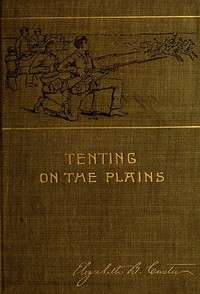
Tenting on the Plains; or, General Custer in Kansas and Texas — Edition Insights
(0 User reviews)
1033
Project Gutenberg
2012
Not confirmed
Generals -- United States -- Biography; Frontier and pioneer life -- West (U.S.); West (U.S.) -- History -- 1860-1890; United States. Army -- Biography; Custer, George A. (George Armstrong), 1839-1876; Custer, Elizabeth Bacon, 1842-1933; United States. Army -- Military life -- History -- 19th century
Readers of public-domain and historical texts
Project Gutenberg digital edition
en
Edition facts
Words
141,504
Reading time
616 min
Text sections
14
Tenting on the Plains; or, General Custer in Kansas and Texas — Edition Insights can be approached with a clearer sense of reading commitment from its source measurements: 141,504 words, 10 hr 16 min estimated reading time, and 14 detected text sections.
The text analysis averages about 27.0 words per sentence, while the detected sections provide another way to judge how the source is divided.
Project Gutenberg metadata also associates the work with “Generals -- United States -- Biography,” connecting these edition facts with the source record’s subject description.
Source:
Project Gutenberg record #40731
Elizabeth B. Custer's memoir of post-Civil War army life with her husband, General Custer, in Kansas and Texas, told through a personal, anecdotal voice that blends domestic detail with frontier danger.
Editorial Edition Score
4.9/5
★★★★★
★★★★★
Calculated from edition completeness, EPUB availability, text structure and catalogue metadata. Not a user rating.
How this score is calculated
- Description quality20 pts
- Title & short description10 pts
- Source metadata20 pts
- Text length15 pts
- Chapters / structure15 pts
- EPUB file integrity20 pts
Total of 100 points, scaled to a 2.5-5.0 range. Editions with an empty description or a missing EPUB file are not scored.
Edition quality
Public-domain source text
Read the source text
The source text is kept in the dedicated reader, separate from this catalogue record and its commentary.
Elizabeth B. Custer opens her memoir not with a grand historical stage but with a domestic negotiation: a friend urging her to break her engagement to George Custer because he might lose a leg. The anecdote establishes the intimate, conversational tone that runs through the book, where personal risk and everyday practicality intertwine. Mrs. Custer writes as a participant, not a chronicler, and her voice—wry, affectionate, and observant—shapes the narrative as much as the events themselves.
A Voice of Domestic Detail
Mrs. Custer’s prose dwells on the material textures of frontier life: the horses, dogs, and servants that made up her household. She describes the greyhound Byron as “lordly,” the bulldog Turk as “ugly” but loyal, and the colt Phil Sheridan as a companion to the dog. These descriptions are not mere color; they reveal her method of building character through physical quirks and relationships. The dogs have personalities, and their interactions with each other and with the humans are rendered with comic precision. Turk’s “little smile” and Phil’s “speaking little snorts” give the animals a vivid presence that anchors the reader in the domestic sphere of a military camp.
Pace Shifts Between Peril and Humor
The narrative moves between moments of tension—prairie fires, floods, attacks—and lighter episodes of domestic comedy. The chapter titles themselves signal this alternation: “A Prairie Fire” sits next to “A Medley of Officers and Men.” In the excerpts, a serious discussion of breaking an engagement gives way to a detailed inventory of horses and dogs. The pacing is not uniform; Mrs. Custer lingers on the bulldog’s appearance and then shifts abruptly to the dangers of the trail. This rhythm suggests a life where danger and domesticity were never far apart, and the writing mirrors that unpredictability.
The Use of Dialogue and Reported Speech
Mrs. Custer frequently incorporates direct speech, as when a friend warns her that Custer “might lose a leg.” These snippets of dialogue give the narrative a sense of immediacy and authenticity, as if the reader is overhearing conversations. She also reports her own thoughts in a colloquial style: “I thought, even then, gay and seemingly thoughtless as I was, that a short life with poverty and a wooden leg was better.” The use of “gay and seemingly thoughtless” is a self-deprecating nod to her own youthful persona, and the reported speech of the “dear old lady” adds a layer of affectionate irony. This technique makes the memoir feel like a spoken reminiscence rather than a formal history.
Readers should attend to the shifts in register—from the formal chapter openings to the intimate asides—as a guide to Mrs. Custer’s narrative strategy. She is not simply recording events but shaping a persona: the loyal wife who is also a keen observer of human and animal behavior. The book rewards attention to its small details, which often carry more weight than the set-piece adventures.
Reading about Elizabeth Custer’s quiet domesticity against the Kansas plains, I remembered my grandfather’s worn copy of the History of the Forty-Eighth Regiment M. V. M. During the Civil War — Edition Insights, and how the same odd intimacy—laundry lists beside battle plans—made that war feel suddenly human, not historical.
There are no reviews for this eBook.
There are no comments for this eBook.
Reader reflection
What was your reading experience?
Capture what you thought, learned, and would like to remember.
Your progress
0
/
10
2
Was reading this book enjoyable?
3
Would you recommend this book to another reader?
4
How easy was the book to follow?
5
Did the book give you something worth debating?
6
Did the book deliver what you hoped for?
7
Would a second reading be valuable?
8
Which aspect of the book did you value most?
9
What is the main idea you are taking away?
10
![Cover of Military Equipment [1917] — A Closer Reading](https://eqook.com/storage/media/covers/pg54213.jpg)