1

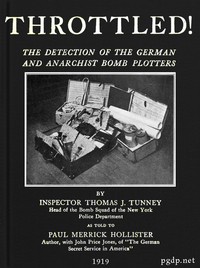
Throttled! The Detection of the German and Anarchist Bomb Plotters — Context and Discussion
(0 User reviews)
255
Project Gutenberg
2020
Not confirmed
World War, 1914-1918 -- Secret service -- Germany
Readers of public-domain and historical texts
Project Gutenberg digital edition
en
Edition facts
Words
64,828
Reading time
282 min
Text sections
16
For Throttled! The Detection of the German and Anarchist Bomb Plotters — Context and Discussion, the stored edition analysis reports 64,828 words, 4 hr 42 min estimated reading time, and 16 detected text sections.
The text analysis averages about 20.1 words per sentence, while the detected sections provide another way to judge how the source is divided.
Project Gutenberg metadata also associates the work with “World War, 1914-1918 -- Secret service -- Germany,” connecting these edition facts with the source record’s subject description.
Source:
Project Gutenberg record #61996
Inspector Thomas J. Tunney's firsthand account of the New York Bomb Squad's pursuit of German and anarchist bomb plotters during World War I, structured around specific cases and featuring recurring images of surveillance, chemical traces, and the movement between city streets and harbor vessels.
Editorial Edition Score
4.8/5
★★★★★
★★★★★
Calculated from edition completeness, EPUB availability, text structure and catalogue metadata. Not a user rating.
How this score is calculated
- Description quality20 pts
- Title & short description10 pts
- Source metadata20 pts
- Text length15 pts
- Chapters / structure15 pts
- EPUB file integrity20 pts
Total of 100 points, scaled to a 2.5-5.0 range. Editions with an empty description or a missing EPUB file are not scored.
Edition quality
Public-domain source text
Read the source text
The source text is kept in the dedicated reader, separate from this catalogue record and its commentary.
Inspector Thomas J. Tunney’s narrative moves through the New York of 1914–1918 as a patchwork of surveilled spaces: hotel lobbies, Jersey garages, and the decks of ships where “Chenango” laborers come and go without a second glance. The book’s structure follows the Bomb Squad’s cases in sequence, each introduced by a new lead—a tip from the French attaché, a suspicious purchase of TNT, a bomb found aboard a vessel. Recurring images of chemical ingredients (chlorate of potash, sulphuric acid) and the physical traces of explosives tie these episodes together, while the squad’s movement between city and harbor underscores the porous border between domestic and foreign threats.
Case-by-Case Architecture
The book is organized not by chronology alone but by discrete investigations, each with its own cast of suspects and informants. Tunney introduces the Kirkoswald bomb, then the Fay bomb materials, then the ship fires—each case a self-contained episode that nonetheless feeds into the larger pattern of German and anarchist activity. The narrative moves from the discovery of a bomb to the tracing of its components, then to the surveillance of suspects, and finally to arrests. This structure mirrors the detective’s own method: follow the material evidence, then the people. The reader is given a series of puzzles, each solved in turn, with the squad’s persistence as the constant thread.
The Harbor as a Theater of Suspicion
Tunney repeatedly returns to the waterfront, where ships become both targets and hiding places. The description of the “Chenango” laborers—hired for a day, speaking many tongues, their faces rarely seen twice—captures the anonymity that frustrates surveillance. The squad watches them “to all points of the compass” and checks for suspicious packages, finding only flasks. This setting recurs: the harbor is a liminal zone where national borders blur, and where the squad must track movements between ship and shore. The image of the harbor as a space of constant, unremarkable transit becomes a key obstacle in the detection of plotters.
Chemical Trails and Paper Trails
The investigation of bomb plots relies heavily on tracing the sale of chemicals. Tunney describes examining “reams of sales’ records” from explosive manufacturers and drug stores, searching for purchases of chlorate of potash and sulphuric acid. The difficulty lies in the mundane uses of these substances—they are “widely and harmlessly used.” The narrative dwells on the tedium of this work, the false leads, and the moment when a new tip (from the French Government) “blew our sugar theory into many and small pieces.” This emphasis on the materiality of evidence—the bomb ingredients themselves—grounds the detective work in the physical world, even as the plotters remain elusive.
The Informant’s Role and the Chain of Custody
A recurring structural element is the chain of intermediaries that connects the bomb squad to the plotters. In the Fay case, the explosive passes from Wettig to Siebs to Breitung to Kienzle to Fay—a “little game of ‘passing the TNT.’” Tunney’s narrative traces this chain step by step, showing how each link is a potential point of surveillance or betrayal. The informant Wettig, introduced by the French attaché, becomes a crucial tool, but the squad must verify each transaction. This focus on the chain of custody—of both evidence and people—reveals the collaborative, often precarious nature of undercover work, where trust is parceled out in small increments.
Readers approaching Throttled! should attend to the way Tunney balances the episodic case structure with the recurring motifs of chemical traces and harbor surveillance. The narrative does not offer a single dramatic arc but a series of interconnected investigations, each revealing a different facet of the bomb squad’s methods. The book’s value lies in its granular detail—the reams of records, the daily routines of watching laborers, the careful tracking of explosive ingredients—rather than in grand revelations. It is a document of procedure, patience, and the slow accumulation of evidence.
Reading Tunney’s account of tracing bomb fragments through harbor fog, I found myself thinking of the quieter, grimmer wait in the trenches across the Channel. That same year, 1917, held its own patient horrors. Somewhere between the chemical traces and the mud, both books share a peculiar stillness—the pause before the fuse burns down, which I carry with me. The British Campaign in France and Flanders, 1917 — Context and Discussion feels like a distant echo of that same heavy air.
There are no reviews for this eBook.
There are no comments for this eBook.
Reader reflection
How will you remember this book?
Save your reaction, strongest insight, and memorable passage.
Your progress
0
/
10
2
What was your overall reaction to the book?
3
Would you recommend this book to another reader?
4
How demanding did the text feel?
5
Would you start a conversation about this book?
6
Which aspect of the book did you value most?
7
Did the book deliver what you hoped for?
8
How original did the book feel?
9
In one sentence, what did you learn?
10