1

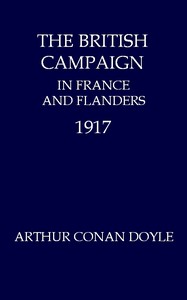
The British Campaign in France and Flanders, 1917 — Context and Discussion
(0 User reviews)
750
Project Gutenberg
2021
Not confirmed
World War, 1914-1918 -- Campaigns -- Western Front
Readers of public-domain and historical texts
Project Gutenberg digital edition
en
Edition facts
Words
89,847
Reading time
391 min
Text sections
10
The catalog record for The British Campaign in France and Flanders, 1917 — Context and Discussion provides practical reading context through 89,847 words, 6 hr 31 min estimated reading time, and 10 detected text sections.
The text analysis averages about 28.5 words per sentence, while the detected sections provide another way to judge how the source is divided.
Project Gutenberg metadata also associates the work with “World War, 1914-1918 -- Campaigns -- Western Front,” connecting these edition facts with the source record’s subject description.
Source:
Project Gutenberg record #65045
Doyle's 1917 volume blends precise unit movements with a novelist's eye for human endurance, tracing the Third Battle of Ypres and Cambrai through official narratives and vivid weather-driven pacing.
Editorial Edition Score
4.9/5
★★★★★
★★★★★
Calculated from edition completeness, EPUB availability, text structure and catalogue metadata. Not a user rating.
How this score is calculated
- Description quality20 pts
- Title & short description10 pts
- Source metadata20 pts
- Text length15 pts
- Chapters / structure15 pts
- EPUB file integrity20 pts
Total of 100 points, scaled to a 2.5-5.0 range. Editions with an empty description or a missing EPUB file are not scored.
Edition quality
Public-domain source text
Read the source text
The source text is kept in the dedicated reader, separate from this catalogue record and its commentary.
Arthur Conan Doyle opens his 1917 campaign history with a striking admission: the events are "cut deep into the permanent history of the world," yet he acknowledges that readers are "still too near" to read the full inscription. This tension between immediate chronicle and lasting record shapes the entire volume. Doyle writes as a military historian who also composed Sherlock Holmes stories, and his prose carries a novelist's attention to pacing: he shifts from broad strategic summaries to close-up accounts of individual brigades, then to the sudden intrusion of weather—"the autumn rain" that begins on the night of July 31 and continues "in a dreary downpour." The narrative voice is authoritative but not omniscient; Doyle repeatedly flags the limits of his sources, noting, for instance, that the censorship "left me untrammelled in the matter of units" but suppressed names below divisional general except for casualties.
The Pacing of Battle and Weather
Doyle structures the Third Battle of Ypres around a dramatic reversal: the first day, July 31, is described as "undoubtedly a British victory," but the victory is qualified—"absolutely complete in the north, and incomplete in the south." Then, in the same paragraph, he introduces the real antagonist: "the constant and formidable ally of the Central Powers, the autumn rain." From that night onward, operations become "really impossible," and Doyle's prose slows to match the slogging pace. He writes of infantry "huddling in the puddles and ditches," of battalions "almost annihilated for military purposes," and of soldiers who, when "the rising waters drove them out, they were shot down by the enemy." The weather is not mere backdrop; it dictates the rhythm of the narrative. Doyle lingers on the physical misery—"impassable mud and unfordable craters"—and even adds a darkly comic note about a "swimming collar" that might have been added to the soldier's burdens. This shift from swift tactical summary to slow, grinding description mirrors the experience of the campaign itself.
Voice and the Limits of Official History
Doyle's narrative voice is that of a careful compiler who nonetheless lets his own judgments surface. He praises the "fiery determination of the British leaders" even as he admits that their attacks were "undertaken at such a desperate disadvantage that large results were out of the question." He records the capture of 6,000 prisoners and 133 officers, but immediately undercuts the triumph by noting the incomplete southern advance. The preface reveals his method: he boasts that in three thick volumes, "it has not yet been shown that a brigade has ever been out of its place," yet he adds, "Such good fortune cannot last for ever. Absit omen!" This blend of precision and superstition is characteristic. Doyle also explains his naming policy—Army and Corps commanders are named, divisional generals only if mentioned in the Headquarters narrative, and all others suppressed except casualties. This transparency about his sources gives the reader a clear sense of what the official record can and cannot reveal.
Recurring Details: Units, Ground, and Human Cost
Doyle's account is built from the movements of specific divisions and brigades. He names the Thirty-ninth, Fifty-first, Welsh, and Guards as capturing their full objectives on July 31, including St. Julien and Pilkem Ridge, while the Fifty-fifth and Fifteenth carried the first and second lines. Later, he tracks the 118th Brigade of the Thirty-ninth Division, which "sustained very heavy losses, some of the battalions being almost annihilated." The ground itself becomes a character: villages like Verlorenhoek and Frezenberg, ridges, redoubts, and woods are listed with the precision of a surveyor. Yet Doyle also pauses for human moments—the regimental staff of the Gordons having to "defend the burrow which served as Headquarters," or the 10th Gordons, 2nd Northamptons, and 1st Sherwood Foresters "fighting for their lives." These details, drawn from official reports, give the narrative a granular texture. The reader is never allowed to forget that behind the division numbers and map coordinates are men lying in improvised trenches, sodden and cold.
Readers should attend to Doyle's use of the word "epic" in the preface—not as hype, but as a deliberate framing of the year 1917 as a period of "definite military ascendancy" for the Allies. The narrative is neither a dry staff report nor a patriotic eulogy; it is a historian's attempt to fix a fluid, muddy, and often chaotic reality into a coherent sequence. Doyle's own caution about the incompleteness of the record—"we are still too near it to read the whole"—invites the reader to treat the volume as a provisional map, one drawn while the ground was still shifting.
That muddy, rain-soaked Ypres felt like the whole war in one season, and I kept returning to how weather shaped every story. Afterwards, idly turning pages, I found One Hundred Cartoons — Edition Insights, whose dry little sketches carried the same quiet endurance, but with lighter boots. The rain stopped. I smiled. That was enough.
There are no reviews for this eBook.
There are no comments for this eBook.
Reader reflection
Record your reading impressions
A brief reflection can help important ideas stay with you longer.
Your progress
0
/
10
2
What was your overall reaction to the book?
3
Would you encourage someone else to read it?
4
How much effort did this book require?
5
Was the book easy to understand?
6
Which element worked best for you?
7
Did any part of the book stay with you emotionally?
8
Did any part of the book feel personally relevant?
9
In one sentence, what did you learn?
10