About 148 minutes
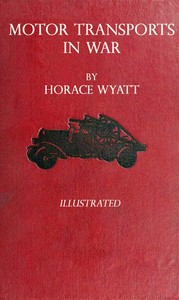
Motor Transports in War — A Reader’s Guide
World Events
33,871 recorded words. 1 minutes difference from this book's estimate.
View Gutenberg source #56323
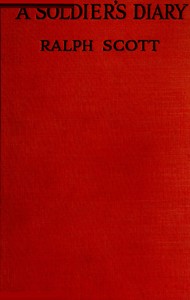
The catalog record for A Soldier's Diary — Edition Insights provides practical reading context through 34,130 words, 2 hr 29 min estimated reading time, and 6 detected text sections.
The text analysis averages about 20.8 words per sentence, while the detected sections provide another way to judge how the source is divided.
Project Gutenberg metadata also associates the work with “World War, 1914-1918 -- Personal narratives, English,” connecting these edition facts with the source record’s subject description.
Explore this collection
These alternatives are selected using recorded categories and estimated reading time.
About 148 minutes
World Events
33,871 recorded words. 1 minutes difference from this book's estimate.
View Gutenberg source #56323About 152 minutes
World Events
34,887 recorded words. 3 minutes difference from this book's estimate.
View Gutenberg source #62816About 133 minutes
World Events
30,492 recorded words. 16 minutes difference from this book's estimate.
View Gutenberg source #68962Search stored excerpts and compare books → Choose by your preferences →
Choices use stored catalog measurements. Estimates vary with reading speed. A shared category is a catalog label, not a claim that two books have the same argument or literary quality.
Search reads excerpt text stored with this catalog and links to its associated Gutenberg record. The connection is stored in the site database; this tool does not recheck that every excerpt is word-for-word identical to that external record. Excerpt search does not cover every chapter and does not verify historical publication dates.
Catalog snapshot checked: 2026-09-25. Coverage: 97 public books, 97 available source excerpts.
Calculated from edition completeness, EPUB availability, text structure and catalogue metadata. Not a user rating.
Total of 100 points, scaled to a 2.5-5.0 range. Editions with an empty description or a missing EPUB file are not scored.
Public-domain source text
The source text is kept in the dedicated reader, separate from this catalogue record and its commentary.
Ralph Scott's diary opens not with a declaration of war but with a description of a shelter: 'a few scattered sheets of corrugated iron, a wagon cover, and the back of a hen shed, reared miraculously against a bank of earth.' This makeshift home, which he notes a pig would scorn, sets the tone for a record that dwells on the physical misery of soldiering—mud, rain, cold, and vermin—rather than heroic action. The preface, by Major-General Sir Frederick Maurice, frames the diary as a corrective to official histories, quoting Scott's own belief that 'the only way to stop war is to tell these facts in the school history books.' The entries that follow bear this out, offering a ground-level view of endurance punctuated by wry literary allusions and a persistent, dark humor.
Throughout the excerpts, weather is not backdrop but antagonist. Scott repeatedly notes rain, flooding, and cold with a precision that conveys their tactical and human cost. On September 10, he writes that 'the weather is our most dangerous foe now,' and that men are 'going down like flies' because there is no shelter. The ground becomes a physical obstacle: 'it often took us twenty minutes to move a hundred yards' through knee-deep slush. Trench-foot reduces companies to half strength. Scott’s own billet floods, and he must shift horses every few hours 'to prevent them sinking.' This relentless focus on elemental conditions—rather than enemy fire—shapes the diary’s distinctive texture. The mud is not merely unpleasant but a force that erodes the army’s capacity to function, making the simplest tasks—moving, sleeping, staying dry—into ordeals.
Scott leavens the grimness with a sardonic voice and unexpected literary references. After a night of floundering in the dark under machine-gun fire, he notes that 'the men swore sublimely and their humour was the only dryness in the night.' He quotes Browning’s lines about a man sprawled 'flat on his belly in the pit’s much mire' to describe his own predicament, finding a grotesque fit between Victorian poetry and trench life. When a persistent rat seeks shelter in his flea bag, he initially turns it out but then relents, only to misinterpret its grateful stroking as an attack. The episode is recounted with a blend of pathos and self-mockery. These moments—the Browning allusion, the rat story, the remark that men in the line 'could tell Dante many things'—reveal a mind trying to make sense of absurdity through culture and irony, even as the body endures cold, wet, and exhaustion.
The preface and Scott’s own October 6 entry explicitly position the diary as a corrective to sanitized accounts of war. Scott argues that history books dwell on 'gallant charges' and 'victorious returns,' while soldiers know the reality of 'misery, suffering, and endurance, the filth, the horror, the desolation.' His entry for the final day, watching Swedish troops change guard, contrasts the spectacle with the truth he has lived: 'there will come a day without music, and no admiring eyes, but when “the lice are in their hair and the scabs are on their tongue.”' The diary itself enacts this counter-narrative by recording not battles but the slow erosion of men by weather, mud, and sleeplessness. It is a deliberate act of testimony, meant to arm future readers against the 'rot' of romanticized war stories. Scott’s voice—keen, unsentimental, occasionally bitter—gives that testimony its force.
Scott’s diary resists easy summary because it is not a story of progress or heroism but of endurance in a landscape that seems designed to defeat both body and spirit. Readers will find no grand offensives or decisive moments; instead, the text accumulates power through its patient, day-by-day catalog of discomfort and small acts of survival. The preface warns that this is not the voice of a 'conscientious objector' but of a 'keen, healthy-minded, sport-loving, young Englishman'—which makes the diary’s bleakness all the more striking. It is a document best read slowly, with attention to the specific weight of each detail.
There’s something about Ralph Scott’s mud-caked pages that stays with you—not the glory, just the weight of another wet night. I sometimes think of that same quiet endurance when I recall the other diary, the one from Gallipoli, where the sand got into everything. Both feel less like history and more like a hand on your shoulder. Gallipoli Diary — Inside the Classic sits beside it now, a familiar, unvarnished voice from another shore.
Create a short personal record of your experience with this book.