1

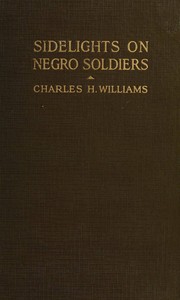
Sidelights on Negro Soldiers — Reading Notes
(0 User reviews)
37
Project Gutenberg
2022
Not confirmed
World War, 1914-1918 -- Participation, African American
Readers of public-domain and historical texts
Project Gutenberg digital edition
en
Edition facts
Words
64,979
Reading time
283 min
Text sections
17
Sidelights on Negro Soldiers — Reading Notes can be approached with a clearer sense of reading commitment from its source measurements: 64,979 words, 4 hr 43 min estimated reading time, and 17 detected text sections.
The text analysis averages about 22.2 words per sentence, while the detected sections provide another way to judge how the source is divided.
Project Gutenberg metadata also associates the work with “World War, 1914-1918 -- Participation, African American,” connecting these edition facts with the source record’s subject description.
Source:
Project Gutenberg record #67093
Charles H. Williams, an investigator for the Federal Council of Churches, documents the conditions, achievements, and treatment of Black soldiers in World War I, based on camp visits, interviews, and official records.
Editorial Edition Score
4.8/5
★★★★★
★★★★★
Calculated from edition completeness, EPUB availability, text structure and catalogue metadata. Not a user rating.
How this score is calculated
- Description quality20 pts
- Title & short description10 pts
- Source metadata20 pts
- Text length15 pts
- Chapters / structure15 pts
- EPUB file integrity20 pts
Total of 100 points, scaled to a 2.5-5.0 range. Editions with an empty description or a missing EPUB file are not scored.
Edition quality
Public-domain source text
Read the source text
The source text is kept in the dedicated reader, separate from this catalogue record and its commentary.
Charles H. Williams opens his 1923 study by stating his purpose: to report on the achievement and living conditions of Negro soldiers in the World War, as seen during eighteen months of investigation under the Federal Council of Churches and the Phelps-Stokes Fund. He notes that he visited camps, interviewed thousands of soldiers, and consulted officers, welfare organizations, and civilians. The preface establishes a documentary tone, grounded in firsthand observation and access to War Department records.
A Documentary Approach to Wartime Experience
The preface and introduction frame the book as an official yet personal account. Williams emphasizes his credentials—appointed with the recommendation of the Secretary of War—and his method: visits, interviews, and study of records. Benjamin Brawley’s introduction places the work in a longer history of Black military service, referencing the Revolution, War of 1812, and Civil War battles like Port Hudson and Fort Wagner. Together, they signal that the book will combine statistical evidence with narrative, aiming to correct public ignorance about Black soldiers’ contributions.
Church and Community Cooperation in the Camps
One excerpt details the role of churches in supporting soldiers. Williams describes varying levels of cooperation: some camps had elaborate arrangements that failed when soldiers did not arrive; other churches provided rest rooms, concerts, and dinners. He singles out Atlanta’s Congregational church for its basement, library, gymnasium, and trained worker for girls’ clubs. San Antonio and Augusta also receive mention—Augusta’s churches sent watermelons and ice cream. The passage shows Williams’s attention to local variation and practical aid, not just official policy.
The Federal Council’s Committee on Negro Troops
Williams explains the formation of the Committee on the Welfare of Negro Troops, chaired by Bishop Wilbur P. Thirkield and including figures like George Foster Peabody, Dr. R. R. Moton, and Dr. James H. Dillard. He and Rev. G. Lake Imes served as field secretaries. Thomas Jesse Jones praised Williams’s reports for thoroughness and constructive recommendations, noting they were sent directly to the War Department. This section reveals the institutional framework behind the investigation and Williams’s role as a conduit between grassroots conditions and military authorities.
Reading the Record as a First-Time Reader
For a reader approaching the book for the first time, the preface and introduction establish a clear lens: this is an investigative report, not a memoir or a comprehensive history. The excerpts suggest that Williams alternates between broad surveys (like church cooperation) and specific cases (like Atlanta’s programs). The book’s structure likely moves from background to conditions in camps to combat performance, but the excerpts only hint at this. Readers should expect data-driven observations tempered by Williams’s stated goal of helping Americans understand the situation and achievement of Black soldiers.
Williams’s book offers a rare contemporary account of Black soldiers’ experiences in World War I, grounded in official access and field investigation. Readers will find a mix of statistical reporting and anecdotal detail, shaped by the author’s dual role as observer and advocate. The excerpts suggest a work that is both documentary and corrective, aiming to inform policy and public opinion alike.
That afternoon, rain drummed against the window while I read Williams’s quiet notes on Black soldiers’ dignity amid indifference. It left a weight, a sense of unheralded endurance. Later, almost idly, I picked up With our army in Flanders — A Closer Reading, and found that same patient ache, just shifted across another muddy horizon.
There are no reviews for this eBook.
There are no comments for this eBook.
Reader reflection
Record your reading impressions
A brief reflection can help important ideas stay with you longer.
Your progress
0
/
10
2
Was reading this book enjoyable?
3
Would you encourage someone else to read it?
4
How demanding did the text feel?
5
Would you start a conversation about this book?
6
Did the story or argument move comfortably?
7
Did the book meet your expectations?
8
How original did the book feel?
9
What did this book teach you most?
10