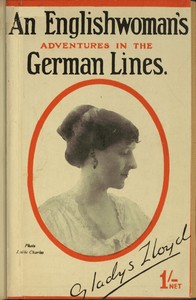
An Englishwoman's adventures in the German lines — Context and Discussion
Edition facts
Gladys Lloyd’s account begins not with a declaration of war but with a single sentence: “Albert has gone.” The baker’s son has been called to the forts, and the village of Manhay is already fraying. From the first paragraph, Lloyd establishes herself as a witness embedded in domestic life—greeting the Job family, sitting on the terrasse, discussing the one topic. The dispatch carrier’s warning that she should leave “to-day—it will be your last chance” sets the stakes, but she stays, held by circumstance and a refusal to walk. The opening is quiet, almost conversational, yet it carries the weight of a decision that will define the narrative.
The Uhlans at the Door
Lloyd’s encounters with German soldiers are marked by a strange, tense cordiality. The Uhlans ask repeatedly, “You do not fear the Germans, Fräulein?”—a question that reveals their own unease as much as hers. She notes their procedures: a patrol can summon reinforcements in twenty minutes, but only after filling out cross-barred paper with name, position, date, hour, regiment, and extra details. The bureaucracy of war strikes her as “far too red-tapey” when enemy patrols are almost upon them. These details—the paper, the blushes, the torn shoulder straps—build a portrait of soldiers who are both occupiers and men caught in a system.
The Cuirassier’s Confidences
One Cuirassier speaks of his family: five brothers serving, a sixth a prisoner in Russia, his father conscripted at sixty-five. He passes the back of his hand across his eyes. Lloyd begins to pity German women “nearly as much” as Belgian peasants, but adds that the former have “suffered no atrocities—as yet.” That qualification is crucial. She does not erase the asymmetry of suffering, but she allows the soldier’s grief to register. When he shows her a map with every fir tree and blade of grass marked, and traces his finger toward Namur, the intimacy of the gesture contrasts with the map’s purpose: it is a tool for invasion.
The Threat of the Spy Label
Lloyd is repeatedly urged to disguise herself as a peasant. The family of Job implores her; the Cuirassier warns that “there are many spies” and that women have been shot before Liège. She refuses: “It seems a skulking thing for a Britisher to do.” Yet the danger is real. She is alone, English, and in a village that is a node of military activity—post office, gendarmerie, inn. The threat is not abstract; it is voiced by the soldiers who might be ordered to shoot her. Her decision to stay visible, to interpret and help, becomes a quiet act of defiance against the logic of suspicion.
The Texture of Waiting
The narrative moves not through battles but through days of waiting. Lloyd records the rhythms: sitting on the terrasse, discussing the one topic, watching the Uhlans come and go. The war is a constant presence, but it is experienced through interruptions—a dispatch carrier’s warning, a Cuirassier’s soft mood, a map brought out and folded. The chapters are short, each titled with a phrase that suggests a discrete episode: “Anything for Bread,” “Fiction v. Fact,” “The Sign of the Red Cross.” This structure mirrors the fragmented, uncertain experience of being caught in a conflict that has not yet fully arrived but is already reshaping every ordinary moment.
Lloyd’s memoir is best read as a document of proximity. She does not claim to understand the war’s larger strategy, nor does she offer a comprehensive account of the German advance. What she provides is a record of what it looked like from a single village—the conversations, the warnings, the small maps, the repeated question “You do not fear the Germans?” The reader should attend to these moments of exchange, where power and vulnerability are negotiated in real time.