1

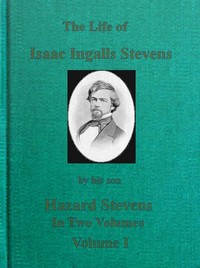
The Life of Isaac Ingalls Stevens, Volume 1 (of 2) — Text and Context
(0 User reviews)
473
Project Gutenberg
2013
Not confirmed
United States -- History -- Civil War, 1861-1865 -- Campaigns; Mexican War, 1846-1848 -- Personal narratives; Northwest, Pacific -- History; Stevens, Isaac Ingalls, 1818-1862; Pacific Coast Indians, Wars with, 1847-1865
Readers of public-domain and historical texts
Project Gutenberg digital edition
en
Edition facts
Words
171,705
Reading time
747 min
Text sections
21
The catalog record for The Life of Isaac Ingalls Stevens, Volume 1 (of 2) — Text and Context provides practical reading context through 171,705 words, 12 hr 27 min estimated reading time, and 21 detected text sections.
The text analysis averages about 21.9 words per sentence, while the detected sections provide another way to judge how the source is divided.
Project Gutenberg metadata also associates the work with “United States -- History -- Civil War, 1861-1865 -- Campaigns,” connecting these edition facts with the source record’s subject description.
Source:
Project Gutenberg record #43589
Hazard Stevens's biography of his father, Isaac Ingalls Stevens, drawn from personal association and extensive correspondence, reveals a figure who negotiated army reform, Coast Survey administration, and Pacific Northwest governance through a self-consciously bold and energetic approach.
Editorial Edition Score
4.9/5
★★★★★
★★★★★
Calculated from edition completeness, EPUB availability, text structure and catalogue metadata. Not a user rating.
How this score is calculated
- Description quality20 pts
- Title & short description10 pts
- Source metadata20 pts
- Text length15 pts
- Chapters / structure15 pts
- EPUB file integrity20 pts
Total of 100 points, scaled to a 2.5-5.0 range. Editions with an empty description or a missing EPUB file are not scored.
Edition quality
Public-domain source text
Read the source text
The source text is kept in the dedicated reader, separate from this catalogue record and its commentary.
Hazard Stevens, an only son who served as his father's chief of staff during the Civil War, opens this biography with a declaration of dual purpose: to do justice to General Stevens's memory and to offer his career as an example for young Americans. The preface names dozens of contributors—fellow generals, senators, engineers, and Indian agents—whose recollections and documents underpin the narrative. This network of witnesses, many of them prominent figures in their own right, signals that the work is less a private memoir than a public record assembled from multiple vantage points.
A Son's Vantage and a Public Record
The preface establishes the biographer's unusual position. Hazard Stevens writes as “an only son, closely associated from boyhood with him,” yet he insists he will “set aside, as far as possible, the bias of filial respect and affection” and simply narrate facts. The list of acknowledgments—including Generals Joseph E. Johnston, G.T. Beauregard, and Joseph Hooker—shows that the project drew on military and civilian networks across sectional lines. The work began in 1877, fifteen years after Isaac Stevens's death, and relied on data furnished by contemporaries, many of whom had since died. This long gestation suggests a deliberate effort to compile a comprehensive account rather than a quick tribute.
Negotiating a Dual Role: Coast Survey and Fort Knox
An excerpt from 1849 shows Isaac Stevens negotiating the terms of his appointment as assistant to Professor Bache of the Coast Survey. He accepted the post only on condition that he could retain charge of the Bucksport works (Fort Knox) for another year, with the option to keep either position afterward. The biographer calls this “unique condition” proof of the esteem in which Stevens was held. Stevens's own letter to his brother Oliver reveals his reasoning: he saw the Coast Survey as needing an overhaul and believed he could be “the army has a representative in me which it has not had in Washington in years.” His language is striking—“I swear by the Eternal, to use Jackson’s expression, I will put it forth”—and suggests a self-conscious emulation of Andrew Jackson's forceful style.
Advice to a Brother: Boldness as a Principle
In the same 1849 letter, Stevens advises his brother Oliver on career choices with remarkable directness: “Remain in Cambridge a year and a half longer. Then go to Boston. Throw yourself into the arena of the strongest men in the State.” He urges boldness as a consistent life strategy: “You and I both do best by taking bold, self-relying courses. I never once failed in my life from the boldness of my course.” This passage, embedded in a biography written by a son, offers a rare glimpse of the subject's own voice and values. The letter also reveals a practical side—Stevens offers financial support and expresses pride in his brother's “weight of character”—but the dominant note is an almost aggressive confidence in assertive action.
Readers approaching this volume should expect a narrative built from official correspondence, personal letters, and the testimony of dozens of contemporaries, filtered through a son's editorial hand. The catalog subjects—Mexican War, Civil War campaigns, Pacific Northwest history, and Indian wars—are all present in the excerpts, but the biography's method is as notable as its content. Hazard Stevens's careful attribution and his father's own vivid prose make this a document worth examining for its construction of a public life as much as for the events it records.
Some biographies stay with you less for their facts than for the grit of a man who measured himself against a wild place. Reading about Isaac Stevens, I kept thinking how certain souls are restless until they shape something. It reminded me of a quieter book, Towards the Great Peace — Key Ideas to Explore, which lingered after I set it down too. Both feel like old maps, tracing paths we’re still walking.
There are no reviews for this eBook.
There are no comments for this eBook.
Reader reflection
What was your reading experience?
Capture what you thought, learned, and would like to remember.
Your progress
0
/
10
2
How much did you enjoy the reading experience?
3
Would you recommend this book to another reader?
4
Did the language feel accessible?
5
How valuable was this book for your own interests?
6
What was the strongest part of the book?
7
Could you see yourself revisiting this book?
8
Did you relate to its people, ideas, or situations?
9
What is the main idea you are taking away?
10