1

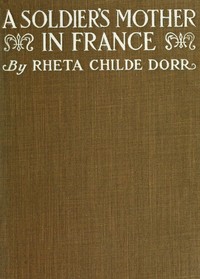
A soldier's mother in France — Reading Notes
(0 User reviews)
38
Project Gutenberg
2022
Not confirmed
World War, 1914-1918 -- Personal narratives, American
Readers of public-domain and historical texts
Project Gutenberg digital edition
en
Edition facts
Words
65,790
Reading time
287 min
Text sections
35
The source record for A soldier's mother in France — Reading Notes measures this digital text at 65,790 words, 4 hr 47 min estimated reading time, and 35 detected text sections.
The text analysis averages about 18.3 words per sentence, while the detected sections provide another way to judge how the source is divided.
Project Gutenberg metadata also associates the work with “World War, 1914-1918 -- Personal narratives, American,” connecting these edition facts with the source record’s subject description.
Source:
Project Gutenberg record #68895
Rheta Childe Dorr reports from France as a mother and correspondent, blending personal anxiety with detailed observations of American soldiers, medical advances, and Red Cross relief work during World War I.
Editorial Edition Score
4.8/5
★★★★★
★★★★★
Calculated from edition completeness, EPUB availability, text structure and catalogue metadata. Not a user rating.
How this score is calculated
- Description quality20 pts
- Title & short description10 pts
- Source metadata20 pts
- Text length15 pts
- Chapters / structure15 pts
- EPUB file integrity20 pts
Total of 100 points, scaled to a 2.5-5.0 range. Editions with an empty description or a missing EPUB file are not scored.
Edition quality
Public-domain source text
Read the source text
The source text is kept in the dedicated reader, separate from this catalogue record and its commentary.
Rheta Childe Dorr opens A soldier's mother in France by describing the service pin she wears—a single ruby star on white—a symbol shared by over a million American women whose sons were in the American Expeditionary Force. That pin, she writes, has come to mean not just sacrifice but “love of country far surpassing the mild patriotism of other days.” Dorr traveled to France as a correspondent, not because she was a woman but despite it, and her account moves between the intimate perspective of a mother and the observational stance of a reporter. The book’s thirty-one chapters, with titles like “I Adopt the American Army” and “The Greatest Mother in the World,” suggest a narrative that weaves personal experience with broader reporting on the war effort.
A Mother’s Star and a Reporter’s Notebook
Dorr’s dual role is established from the first chapter. She wears the service pin for her son but declares she now wears it “for the American army.” This shift from private to public grief and pride recurs throughout the excerpts. In Chapter XVI, she details the fight against trench fever, noting that the trench louse, “once called a nuisance, is now known to be almost as dangerous as the stegomya mosquito.” She praises the volunteer soldiers who risked themselves in experiments, then asks pointedly: “what honors and rewards those simple soldiers are going to receive.” That question—about recognition for ordinary men—echoes her earlier insistence that the service pin should mean more than sacrifice. Dorr’s voice is direct, sometimes wry, and she frequently addresses the reader as a fellow American, as when she tells donors how their money was spent: “All on your money, you fortunate, generous, tender hearted givers.”
Scenes of Relief and Medical Progress
In Chapter XVII, Dorr describes a night spent fitting shoes to refugee children in the basement of the Gare du Nord. She picks up a four-year-old boy whose feet are “literally on the ground,” and the scene is rendered with precise, unsparing detail: the children’s “little white, dirty, tired faces,” their “round black eyes” fixed on a pile of shoes. The Red Cross operation is presented as a direct link between American donors and French refugees. Elsewhere, Dorr reports on the evacuation of wounded men from a hospital that “had got too hot to hold invalids,” noting the slow trains that took twenty-four hours to travel fifty miles. She records the men’s complaints—one says English nurses are “dreadful stern”—and their eagerness to leave, which the head physician interprets as a sign of recovery. These vignettes ground the war in concrete, human-scale moments.
The Army as a Collective Subject
Dorr’s reporting often treats the American army as a single, almost familial entity. She writes of “our sons” and “our boys,” but she also observes the army’s internal diversity. Chapter titles like “Our Foreign Legion” and “The Man Without a Country” hint at the range of soldiers she encountered. In the trench fever chapter, she credits “our keen army and Red Cross surgeons” while insisting that the enlisted volunteers deserve equal recognition. Her perspective is consistently that of an outsider who has become an insider: she is a mother, a correspondent, and a witness. The book’s structure—moving from the personal pin to the army as a whole—suggests a deliberate expansion of focus. Dorr does not claim to have seen every front, but she offers what she calls “that army as I have just seen it in France,” a phrase that underscores the limits and the authority of her firsthand account.
Dorr’s account is valuable for its specific, ground-level observations of medical care, refugee relief, and the daily texture of American involvement in France. Readers should note that the excerpts cover only a portion of the book; the full text includes chapters on topics like “Beauty as Usual” and “Clemenceau the Tiger.” Dorr’s voice—maternal, reportorial, and occasionally sharp—offers a distinctive angle on the war, one that balances pride with a clear-eyed view of suffering and bureaucracy.
I keep thinking about how Dorr braided that anxious waiting with the smallest details of hospital linens and soldiers’ gestures—the way a mother’s eye lands where official histories don’t. This morning, turning through Historical records of the Buffs, East Kent Regiment (3rd Foot) — A Reader’s Guide, I felt the same ache: all those names, so orderly, yet each one someone’s boy. It’s a quieter grief, remembering both.
There are no reviews for this eBook.
There are no comments for this eBook.
Reader reflection
What was your reading experience?
Capture what you thought, learned, and would like to remember.
Your progress
0
/
10
2
How did the book work for you overall?
3
Would you encourage someone else to read it?
4
How demanding did the text feel?
5
How much did the book move you?
6
How distinctive were its ideas or approach?
7
How did the pace of the book feel?
8
What was the strongest part of the book?
9
In one sentence, what did you learn?
10