
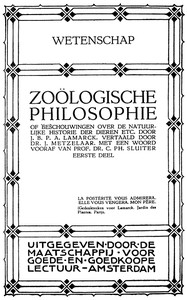
Zoölogische Philosophie by Jean Baptiste Pierre Antoine de Monet de Lamarck
Let's be clear: this isn't a novel with a plot. There's no hero's journey, unless you count the journey of life itself. Zoological Philosophy is Lamarck laying out his grand, unified theory for how the natural world works. He looks at everything from the simplest microbe to the most complex human and tries to explain how we all got here.
The Story
The 'story' is Lamarck's argument. He starts with a bold idea: life isn't static. Species change over vast amounts of time. But his engine for change is what's fascinating. He believed that if an animal constantly used an organ—like a giraffe stretching its neck for high leaves—that organ would develop and grow. Even wilder, he thought these acquired characteristics could be passed directly to its offspring. Over generations, necks get longer, moles become blind from living underground, and birds develop webbed feet from stretching their toes in water. For Lamarck, every creature is on a path from simple to complex, driven by an inner feeling of need, all arranged on a great ladder of being.
Why You Should Read It
You read this not because he was right, but because his thinking was so bold and creative. It's a masterpiece of scientific imagination. Feeling the conviction in his writing is thrilling. He's piecing together a puzzle with half the pieces missing, and his solution is elegant, intuitive, and completely wrong in the details. It makes you appreciate how hard it is to get science right. You also see the seeds of modern ideas here—the concept of deep time, the relationship between animals and their environment, and the fact that species do change. Reading Lamarck makes Darwin's later theory of natural selection seem even more brilliant by contrast, because you understand the intellectual hurdle Darwin had to overcome.
Final Verdict
This is for the curious reader who loves the history of ideas. It's perfect for science fans who want to understand the roads not taken, or for anyone who enjoys seeing a great mind at work, even when it stumbles. It's not a light read—the language is from the early 1800s—but it's surprisingly accessible for a foundational science text. If you've ever wondered where old, discarded ideas like 'use and disuse' come from, meet the man who gave them life. Just be prepared to have your modern brain constantly whispering, 'But wait...'
No rights are reserved for this publication. Knowledge should be free and accessible.
Linda Moore
10 months agoIt took me a while to process the complex ideas here, but the historical context mentioned in the early chapters is quite enlightening. A perfect balance of theory and practical advice.
Emily Sanchez
2 years agoFive stars!
Paul Miller
3 months agoThought-provoking and well-organized content.