1

With my regiment — A Closer Reading
(0 User reviews)
441
Project Gutenberg
2024
Not confirmed
World War, 1914-1918 -- Personal narratives, English
Readers of public-domain and historical texts
Project Gutenberg digital edition
en
Edition facts
Words
48,524
Reading time
211 min
Text sections
25
For With my regiment — A Closer Reading, the stored edition analysis reports 48,524 words, 3 hr 31 min estimated reading time, and 25 detected text sections.
The text analysis averages about 21.0 words per sentence, while the detected sections provide another way to judge how the source is divided.
Project Gutenberg metadata also associates the work with “World War, 1914-1918 -- Personal narratives, English,” connecting these edition facts with the source record’s subject description.
Source:
Project Gutenberg record #73692
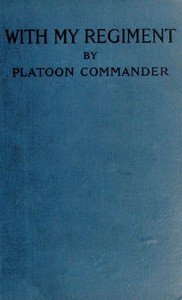
A platoon commander's firsthand account of moving from the Aisne to La Bassée in 1914, focusing on the daily logistics, billeting, and the shift from peacetime routine to the realities of trench warfare.
Editorial Edition Score
4.8/5
★★★★★
★★★★★
Calculated from edition completeness, EPUB availability, text structure and catalogue metadata. Not a user rating.
How this score is calculated
- Description quality20 pts
- Title & short description10 pts
- Source metadata20 pts
- Text length15 pts
- Chapters / structure15 pts
- EPUB file integrity20 pts
Total of 100 points, scaled to a 2.5-5.0 range. Editions with an empty description or a missing EPUB file are not scored.
Edition quality
Public-domain source text
Read the source text
The source text is kept in the dedicated reader, separate from this catalogue record and its commentary.
The narrative opens not with a battle scene but with a pink telegraph envelope and the word "Group"—the long-anticipated signal for mobilization. Arthur Mills, writing under the pseudonym "Platoon Commander," immediately establishes a voice that is both matter-of-fact and subtly ironic, describing his own "levity" as he packs for war. The introduction sets a tone of calm resolve, embodied by a hostess who is "a mother of soldiers," dispatching her sons to the front. This domestic framing gives way to the practicalities of moving a draft to France, where the author's attention to detail—counting men into barns, negotiating with French farmers, and finding a bed in a cottage—reveals a narrative that values the concrete over the heroic.
The Rhythm of Billeting
Mills devotes considerable space to the mechanics of quartering troops, treating it as a skill to be mastered. In one episode, he and a fellow officer guarantee to billet 200 men in a village of two farms and four cottages within fifteen minutes. The prose becomes almost technical: "The eye quickly gets trained to know what amount of men will go into what space." Barns, stables, and outhouses are assessed with a surveyor's precision. The author notes that French barns "always have plenty of straw" and make "warm, snug lying." This attention to shelter and logistics—counting men in by torchlight, transferring the last twenty-five from a porch to a barn—gives the account a grounded, step-by-step quality. The reader is made to feel the weight of wet boots and the relief of a mattress, details that accumulate into a portrait of war as a series of small, urgent arrangements.
Voice and the Officer's Perspective
The narrative voice is that of a junior officer who is both participant and observer. Mills writes with a dry, understated humor—his landlady is "aghast at the National crisis, and rather shocked at my levity"—and a willingness to admit uncertainty. He describes the "happy, careless—some people say, rather useless—life of the army officer in peace time" without defensiveness. The tone shifts when he recounts the kindness of a Tommy who offers the officers a room at the back of a cottage, noting that "the little class distinctions between officer and man are to a certain extent preserved on active service." This observation, offered without sentimentality, reveals a narrator attentive to the social codes that persist even under fire. The voice remains consistently that of a platoon commander, not a general or a journalist: concerned with his men, his orders, and the next billet.
Pace and the Lull Before Action
The excerpts show a deliberate alternation between movement and stillness. After the initial rush of mobilization, the narrative slows to describe the process of billeting in minute detail: the search for barns, the negotiation with the Adjutant, the stew of "bully beef and vegetables" cooked over a fire. The pace is unhurried, almost domestic, until a sudden shift—"Report yourself to O.C. 1st Battalion at —— immediately"—jolts the reader back to the urgency of war. This rhythm of hurry and halt, of waiting and moving, is central to the memoir's structure. Mills does not rush toward the firing line; he lingers on the moments in between, the "joy of throwing off our wet boots and coats" and stretching out on a mattress. The effect is to make the reader feel the weight of time itself, the long hours that precede any attack.
Readers approaching this memoir should expect a narrative that values the quotidian over the spectacular. Mills is less interested in the grand sweep of strategy than in the texture of a single night's billeting or the taste of a stew shared with men. The pseudonym "Platoon Commander" signals a perspective that is deliberately limited, grounded in the immediate and the practical. For those seeking an account of how war is actually lived—day by day, barn by barn, mile by mile—this book offers a rare, unadorned record.
That afternoon, the rain against the windows blurred the pages of With my Regiment, and I lost myself in the quiet weight of a young officer’s kitbag—rations, letters, orders. The way he measured home by footsteps between billets felt achingly human. Later, nearly by accident, I reached for Passed by the censor — A Closer Reading, and found that same measured voice, only closer to the bone.
There are no reviews for this eBook.
There are no comments for this eBook.
Reader reflection
Record your reading impressions
A brief reflection can help important ideas stay with you longer.
Your progress
0
/
10
2
Did this book hold your interest?
3
How likely are you to recommend this book?
4
How easy was the book to follow?
5
What did you think about the pace?
6
What was the strongest part of the book?
7
Did anything about the book feel genuinely new?
8
Did the book meet your expectations?
9
What is the main idea you are taking away?
10