1

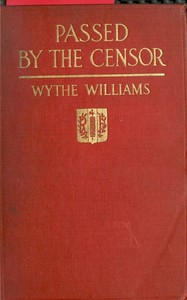
Passed by the censor — A Closer Reading
(0 User reviews)
1341
Project Gutenberg
2022
Not confirmed
World War, 1914-1918 -- Personal narratives, American
Readers of public-domain and historical texts
Project Gutenberg digital edition
en
Edition facts
Words
58,435
Reading time
255 min
Text sections
6
For Passed by the censor — A Closer Reading, the stored edition analysis reports 58,435 words, 4 hr 15 min estimated reading time, and 6 detected text sections.
The text analysis averages about 16.3 words per sentence, while the detected sections provide another way to judge how the source is divided.
Project Gutenberg metadata also associates the work with “World War, 1914-1918 -- Personal narratives, American,” connecting these edition facts with the source record’s subject description.
Source:
Project Gutenberg record #68970
Wythe Williams, Paris correspondent for the New York Times, recounts his experiences covering World War I from the French front lines, navigating military censorship and offering a journalist's perspective on war's human toll.
Editorial Edition Score
4.7/5
★★★★★
★★★★★
Calculated from edition completeness, EPUB availability, text structure and catalogue metadata. Not a user rating.
How this score is calculated
- Description quality20 pts
- Title & short description10 pts
- Source metadata20 pts
- Text length15 pts
- Chapters / structure15 pts
- EPUB file integrity20 pts
Total of 100 points, scaled to a 2.5-5.0 range. Editions with an empty description or a missing EPUB file are not scored.
Edition quality
Public-domain source text
Read the source text
The source text is kept in the dedicated reader, separate from this catalogue record and its commentary.
Wythe Williams, Paris correspondent for the New York Times, opens his account by distinguishing himself from the many "special" correspondents who briefly visited the war zone. He was a "regular"—already living in Europe when war erupted—and his book attempts to describe "a journalist's methods in covering the biggest, the hardest 'story' that newspapers were ever compelled to handle." The preface, dated October 1915, sets a pragmatic tone: the cable remained intact, the American public demanded news with breakfast, and correspondents had to improvise plans on the minute. Williams frames his narrative as a professional's report, not a romance or history.
The Censor's Stamp and the Journalist's Vantage
The title Passed by the Censor signals the central constraint under which Williams wrote. Every dispatch had to survive military review before reaching American readers. In the preface, he notes that correspondents were "permitted to enter the forbidden territory" and "allowed to tell what they saw there" only by the censor's favor. This condition shapes the book's perspective: Williams cannot claim full disclosure, but he can show what the authorities deemed acceptable. Readers should watch for moments where he hints at what might be omitted—the gaps between official permission and lived experience. The endorsement by Georges Clemenceau, then former Premier, adds another layer: Clemenceau praises Williams for coupling the idea of an "invincible" army with "humanity," suggesting the censor passed not just facts but a particular moral framing.
Scenes of Displacement: Refugees and the Texture of Waiting
One extended excerpt describes refugees at a freight yard near Quesnoy-sur-Somme. Williams renders the scene in sensory detail: the "coldest gray" sky, the ooze of the yards, a child with a "fat slab of bread covered thickly with red jam" who shouts "Vive la France!" while her mother plods silently, eyes fixed on the mud. The contrast between the children's glee and the adults' listlessness is sharp. The refugees accept food without looking up; they shrug and say, "C'est la guerre!" An old man, nearly blind and lame, is delighted by a gift of English tobacco. Williams does not editorialize—he records gestures, glances, and the mechanical movements of soldiers herding people into cattle cars. The passage conveys displacement without melodrama, letting small details accumulate.
The Ambulance Race: Speed and Fragility
Williams describes driving an ambulance through the freight yards, racing wounded men to the hospital. The prose is terse and kinetic: "We plowed our way carefully through the ooze," the engine stalls, he gets out to crank it. The wounded are sorted, the less desperate cases entrained. A Zouave on a stretcher groans horribly as a yard engine shrieks past. The ambulance columns have worked through the night. Williams presents himself as a participant—helping carry hampers, handing out food—but his focus remains on the machinery of evacuation: the sorting, the entraining, the "race against time." The scene underscores the precariousness of survival: the wounded reach the hospital "alive," but barely. The narrative rhythm mirrors the urgency, with short sentences and abrupt shifts between action and observation.
Clemenceau's Endorsement and the Question of Perspective
Georges Clemenceau's endorsement, printed before the main text, offers an external judgment on Williams's work. Clemenceau expresses surprise that "the eye of a foreigner should have been so penetrating" and that Williams linked military power with "humanity." This endorsement frames the book as a sympathetic portrait of the French army and people, but it also raises questions about Williams's position: he is an accredited correspondent, embedded with the French forces, and his account necessarily reflects that alignment. Readers should consider how his access and his need to pass the censor shape what he emphasizes—the resilience of civilians, the professionalism of soldiers, the moments of kindness amid destruction. The endorsement is itself a historical artifact, showing how the book was received by French authorities.
Williams's narrative moves between the correspondent's desk and the front-line mud, between official permission and human reality. The excerpts show a writer attentive to small gestures—a child's laugh, an old man's pipe—that resist the abstraction of war. Readers will find not a comprehensive history but a journalist's on-the-ground record, shaped by the censor's stamp and the limits of what could be cabled home. The book rewards attention to what is shown and what is left unsaid.
There were nights in Paris when Wythe’s dispatches made the war feel like a whispered secret, each censored line a half-open door. I still carry that ache for what words can’t quite say. It made me curious how The Jesuits — Reading Companion treats silence as a kind of listening, a patient art I’d never considered before.
There are no reviews for this eBook.
There are no comments for this eBook.
Reader reflection
Record your reading impressions
A brief reflection can help important ideas stay with you longer.
Your progress
0
/
10
2
How did the book work for you overall?
3
Would you pass this book on to a friend?
4
What was the reading difficulty like?
5
Could you see yourself revisiting this book?
6
Did anything about the book feel genuinely new?
7
What was the strongest part of the book?
8
Was the book what you thought it would be?
9
What is the main idea you are taking away?
10