1

Pan-Germany — Story, Setting & Ideas
(0 User reviews)
380
Project Gutenberg
2023
Not confirmed
World War, 1914-1918; Pangermanism
Readers of public-domain and historical texts
Project Gutenberg digital edition
en
Edition facts
Words
32,414
Reading time
141 min
Text sections
15
Before opening Pan-Germany — Story, Setting & Ideas, the edition data offers a quick orientation: 32,414 words, 2 hr 21 min estimated reading time, and 15 detected text sections.
The text analysis averages about 28.7 words per sentence, while the detected sections provide another way to judge how the source is divided.
Project Gutenberg metadata also associates the work with “World War, 1914-1918,” connecting these edition facts with the source record’s subject description.
Source:
Project Gutenberg record #70909
André Chéradame's 1917 pamphlet, reprinted from The Atlantic Monthly, argues that Pan-Germanism is a feudal conspiracy threatening global liberty. The text combines strategic analysis with moral warning, drawing on two decades of the author's research.
Editorial Edition Score
4.7/5
★★★★★
★★★★★
Calculated from edition completeness, EPUB availability, text structure and catalogue metadata. Not a user rating.
How this score is calculated
- Description quality20 pts
- Title & short description10 pts
- Source metadata20 pts
- Text length15 pts
- Chapters / structure15 pts
- EPUB file integrity20 pts
Total of 100 points, scaled to a 2.5-5.0 range. Editions with an empty description or a missing EPUB file are not scored.
Edition quality
Public-domain source text
Read the source text
The source text is kept in the dedicated reader, separate from this catalogue record and its commentary.
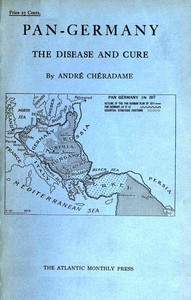
André Chéradame's Pan-Germany: The Disease and Cure (1917) opens with a prefatory letter from New Hampshire officials framing the book as a warning to loyal Americans. The pamphlet reprints articles from The Atlantic Monthly and presents itself as an inexpensive edition for wide circulation. Chéradame, described as a French publicist who has studied the Pan-German scheme for over twenty years, argues that Prussian militarism has extended over new territories, enabling Germany to prolong the war by exploiting conquered populations and resources.
The Author's Authority and the Pamphlet's Purpose
The editorial note preceding the text asserts that Chéradame has devoted more than twenty years to investigating the Pan-German conspiracy, and that his earlier books now read like prophecies. This claim positions the author as a prescient expert, though the excerpts provide no evidence of his specific predictions. The pamphlet's stated purpose is to give Americans a clear understanding of the war's meaning, and it is published under the auspices of the New Hampshire branch of the National Security League. The prefatory letter from Governor Henry W. Keyes and other officials explicitly calls for readers to support the war effort, blending informational and patriotic aims.
Strategic and Economic Arguments Against Pan-Germany
Chéradame's central argument is that Pan-Germany, if allowed to persist, would dominate Europe by controlling 176 million people and strategic positions like the Dardanelles. He warns that Berlin could then launch an expedition against the United States. The text emphasizes that the Allies must destroy Pan-Germany, not the German people, and that the United States has a vital interest in this outcome. The author uses concrete details: the Hamburg-Bagdad, Antwerp-Bagdad, and Brest-Bagdad railways are cited as Pan-German ambitions, and Brest is described as coveted for a transatlantic port. These specifics ground the argument in geopolitical analysis rather than mere rhetoric.
Moral and Feudal Dimensions of the Conflict
Chéradame frames the war as a struggle between republican America and a four-ply feudal spirit comprising Prussian Junkers, Austrian landowners, Magyar grandees, and Turkish feudalism. This moral argument is intertwined with strategic warnings: if Pan-Germany triumphs, Americans would face militarism and an inevitable struggle. The text's language is urgent and declarative, using phrases like 'intolerable' and 'must be destroyed.' The author does not provide evidence for the existence of a unified Pan-German conspiracy but asserts it as established fact. The excerpts suggest that the pamphlet aims to mobilize American opinion by combining fear of invasion with ideological opposition to feudalism.
Readers should note that this pamphlet is a wartime document, not a neutral analysis. Its claims about Pan-German plans and resources are presented as certain, but the excerpts offer no citations or counterarguments. The text's value lies in its reflection of Allied propaganda strategies and the specific fears—railway networks, feudal conspiracies, transatlantic invasion—that were deployed to sway American readers in 1917-1918.
Sometimes a book stays with the way a season does, quietly. That old pamphlet about Pan-Germanism felt like watching someone map a storm they saw coming, and it reminded me of another account, Four Months in Libby and the Campaign Against Atlanta — Themes and Context, where the waiting and the watching are just as heavy. A certain patience in horror lingers.
There are no reviews for this eBook.
There are no comments for this eBook.
Reader reflection
What was your reading experience?
Capture what you thought, learned, and would like to remember.
Your progress
0
/
10
2
Did this book hold your interest?
3
Would you pass this book on to a friend?
4
How demanding did the text feel?
5
Would you like to discuss this book with someone?
6
Could you follow the author’s main argument?
7
Did the book offer a fresh perspective?
8
Which aspect of the book did you value most?
9
What is the main idea you are taking away?
10