1

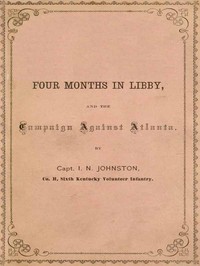
Four Months in Libby and the Campaign Against Atlanta — Themes and Context
(0 User reviews)
607
Project Gutenberg
2017
Not confirmed
United States -- History -- Civil War, 1861-1865 -- Personal narratives; Atlanta Campaign, 1864; Libby Prison; United States. Army. Kentucky Infantry Regiment, 6th (1861-1864)
Readers of public-domain and historical texts
Project Gutenberg digital edition
en
Edition facts
Words
34,500
Reading time
150 min
Text sections
14
Before opening Four Months in Libby and the Campaign Against Atlanta — Themes and Context, the edition data offers a quick orientation: 34,500 words, 2 hr 30 min estimated reading time, and 14 detected text sections.
The text analysis averages about 30.8 words per sentence, while the detected sections provide another way to judge how the source is divided.
Project Gutenberg metadata also associates the work with “United States -- History -- Civil War, 1861-1865 -- Personal narratives,” connecting these edition facts with the source record’s subject description.
Source:
Project Gutenberg record #54065
A firsthand account by Captain I. N. Johnston of the 6th Kentucky Infantry, detailing his four months in Libby Prison and a daring escape, followed by his participation in Sherman's Atlanta Campaign. The narrative is marked by plain, unadorned prose and a focus on practical survival, with notable attention to the ambiguous roles of enslaved people and white civilians encountered during the flight.
Editorial Edition Score
4.7/5
★★★★★
★★★★★
Calculated from edition completeness, EPUB availability, text structure and catalogue metadata. Not a user rating.
How this score is calculated
- Description quality20 pts
- Title & short description10 pts
- Source metadata20 pts
- Text length15 pts
- Chapters / structure15 pts
- EPUB file integrity20 pts
Total of 100 points, scaled to a 2.5-5.0 range. Editions with an empty description or a missing EPUB file are not scored.
Edition quality
Public-domain source text
Read the source text
The source text is kept in the dedicated reader, separate from this catalogue record and its commentary.
Captain I. N. Johnston opens his 1864 memoir with a plain-spoken apology for his "unpracticed pen," yet immediately stakes a claim to authority: he was an inmate of "the foulest of Southern prisons" and a participant in "one of the most remarkable escapes known to history." The book is divided into two distinct halves—the Libby Prison ordeal and the subsequent Atlanta Campaign—but the voice remains consistently that of a soldier who values incident over style. Johnston writes for his comrades, not for a literary audience, and his narrative is built from concrete details: the taste of hot coffee after months of deprivation, the feel of frozen clothes, the risk of trusting a stranger.
The Unreliable Ally: Trust and Betrayal in the Escape
Johnston’s escape narrative repeatedly tests the reliability of helpers. A "faithful negro sentinel" who stands guard and guides the party is praised for the "warm heart which beat in that black man's breast." Yet immediately afterward, a white civilian who claims to be neutral and offers advice is discovered to have lied about the location of a picket post, nearly betraying the fugitives. Johnston’s account does not generalize: each encounter is judged on its own merits, and the reader is left with a pattern of uncertainty. The escaped prisoners must weigh every word and gesture, knowing that a single misjudgment could mean recapture.
The Body Under Duress: Cold, Hunger, and Exhaustion
Physical suffering is rendered in specific, unembellished terms. Johnston notes that after a night of travel, their clothes were "so wet and frozen" that they had to keep moving to avoid "being perfectly benumbed with cold." The first good meal in months is described not with hyperbole but with the simple detail that they had coffee to add to the hosts' store. The body’s needs—warmth, rest, food—drive the narrative forward. Johnston does not dwell on emotion; he reports the state of his limbs and the scarcity of supplies. This material focus gives the escape a tactile urgency that literary flourishes would only dilute.
The Campaign as Coda: Sherman’s March Through a Soldier’s Eyes
Johnston acknowledges that the second half of his book—the Atlanta Campaign—"will, perhaps, have less interest for the general reader," but he includes it for those who shared the march. The shift from prison to campaign is abrupt, and the tone changes from the tense, close-up perspective of the escape to a broader operational view. Yet the same plain style persists: Johnston records movements, skirmishes, and the weariness of the march without grand pronouncements. The campaign section functions as a return to the soldier’s ordinary world after the extraordinary ordeal of Libby, grounding the narrative in the collective experience of Sherman’s army rather than individual heroism.
Johnston’s memoir is best read as two linked but distinct documents: a prison-escape thriller and a campaign chronicle. Readers interested in the mechanics of escape—the negotiation of trust, the management of the body’s limits—will find the first half especially vivid. Those seeking a soldier’s-eye view of the Atlanta Campaign will appreciate the second half’s unvarnished report. The book’s value lies not in its literary polish but in its directness; Johnston writes as if he is still speaking to the men who shared his fire.
Captain Johnston's plain words about survival in Libby Prison remind me of an old, quiet ledger—each entry necessary, nothing wasted. There is a similar restraint in The Jesuits — Reading Companion, where discipline and reflection walk hand in hand. Both books trust the reader to find the deeper current beneath their unassuming surfaces. That kinship sits quietly on my shelf, content to be discovered in its own time.
There are no reviews for this eBook.
There are no comments for this eBook.
Reader reflection
What did you think of this book?
Answer a few questions and save a private reflection on this device.
Your progress
0
/
10
2
How much did you enjoy the reading experience?
3
Is this a title you would suggest to others?
4
How much effort did this book require?
5
How distinctive were its ideas or approach?
6
Did any part of the book feel personally relevant?
7
Could you apply anything you learned?
8
How would you describe its reading pace?
9
Which lesson or insight stayed with you?
10