1

Ladies' dress shoes of the nineteenth century — Key Ideas to Explore
(0 User reviews)
387
Project Gutenberg
2025
Not confirmed
Women's shoes -- History -- 19th century; Women's shoes -- History -- 19th century -- Pictorial works
Readers of public-domain and historical texts
Project Gutenberg digital edition
en
Edition facts
Words
6,153
Reading time
27 min
Text sections
1
This digital edition of Ladies' dress shoes of the nineteenth century — Key Ideas to Explore is described by source-level measurements including 6,153 words, 27 min estimated reading time, and 1 detected text section.
The text analysis averages about 21.3 words per sentence, while the detected sections provide another way to judge how the source is divided.
Project Gutenberg metadata also associates the work with “Women's shoes -- History -- 19th century,” connecting these edition facts with the source record’s subject description.
Source:
Project Gutenberg record #75531
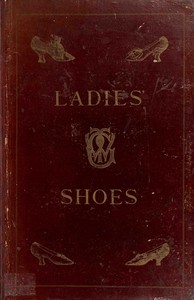
T. Watson Greig's 1900 catalog of 63 nineteenth-century ladies' dress shoes, with detailed descriptions of materials, ornamentation, and construction, organized by plate and accompanied by illustrations.
Editorial Edition Score
4.4/5
★★★★★
★★★★★
Calculated from edition completeness, EPUB availability, text structure and catalogue metadata. Not a user rating.
How this score is calculated
- Description quality20 pts
- Title & short description10 pts
- Source metadata20 pts
- Text length15 pts
- Chapters / structure15 pts
- EPUB file integrity20 pts
Total of 100 points, scaled to a 2.5-5.0 range. Editions with an empty description or a missing EPUB file are not scored.
Edition quality
Public-domain source text
Read the source text
The source text is kept in the dedicated reader, separate from this catalogue record and its commentary.
T. Watson Greig's Ladies' Dress Shoes of the Nineteenth Century (1900) presents sixty-three shoes, each illustrated and described in a sequence of plates. The work is structured as a visual catalog, moving from one specimen to the next with little connective narrative. Greig's descriptions consistently foreground material, color, and ornament—green velvet, royal blue satin, steel beads, gold thread—while also noting the shoe's provenance or the wearer's identity. The preface states the shoes were 'worn by ladies of the 19th century' and selected to illustrate 'variety and change of fashion.'
The book's movement between plates is not chronological but thematic, grouping shoes by color, material, or style. For instance, Plate II shows three black satin shoes, while Plate XIX features an Oxford shoe and two deep red specimens. This arrangement invites the reader to compare adjacent examples, noticing subtle shifts in heel shape, toe form, and decorative detail.
Structure as a Sequence of Specimens
The book's primary organizational unit is the plate, each containing one to three shoes. Greig offers no overarching narrative; instead, he moves from one plate to the next with minimal transition. The preface establishes the collection's purpose—to illustrate fashion's variety—but the body itself is a series of discrete observations. This structure mirrors a physical album or museum display, where each shoe is an isolated artifact. The reader is free to browse, comparing the 'very square toe' of an early black satin shoe (Plate II) with the 'pointed toe' of a later specimen. The lack of chronological ordering means that a shoe from the 1880s may appear next to one from the 1840s, emphasizing formal rather than historical relationships.
Recurring Images: Heels, Toes, and Ornament
Throughout the descriptions, certain features recur with notable frequency. The 'Louis heel' appears in multiple plates—Plate II, III, XIX—often paired with a pointed toe. Greig uses this term without explanation, assuming the reader's familiarity. The 'Magpie' colors (black and white) are praised in Plate I, and the combination of red and white satin is singled out for its 'vivid contrast' in Plate XX. Ornamentation is described in precise terms: 'embroidered finely with steel,' 'gold thread picked out with white beads,' 'rows of beads alternate red and gold.' These recurring elements create a visual vocabulary that the reader learns to recognize across plates. The 'Jubilee Shoe' (Plate II) introduces a motif of commemorative embroidery—'V.R.' and 'God save the Queen'—which reappears in the 1897 version.
Movement Between Plates: Contrast and Continuity
Greig often pairs plates to highlight contrast or continuity. Plate I presents three shoes of similar shape but varied decoration, while Plate II shows three black satin shoes that 'serve to show the many modern improvements' of the later examples. The transition from Plate I to Plate II shifts from multicolored kid and velvet to monochrome satin, inviting the reader to consider how material affects perception. Later, Plate XIX moves from a 'particularly small and neat' Oxford shoe to a deep red shoe with gold embroidery, then to another crimson shoe with beadwork. This sequence emphasizes variation within a color family. The final plate (XX) introduces a brocade shoe and a red-and-white satin shoe with an unusual loose vamp, ending with a shoe owned by Rosa Anderson—a rare narrative aside that momentarily breaks the catalog's pattern.
The Role of Provenance and Wearer
Although the book is primarily a catalog of objects, Greig occasionally includes details about the shoes' owners. The shoe of Mrs Macandrew of Dalcross Castle is noted for its 'want of size' and the owner's 'good taste.' The bronze stage shoe of actress Miss Ada Cavendish (Plate III) links the collection to performance. The most extended narrative appears in Plate XX, where the shoe of Rosa Anderson is accompanied by a brief account of her elopement, which 'created a great sensation.' These moments are rare—most shoes are described without personal history—but they hint at the social lives these objects participated in. The reader is left to wonder about the other owners: the 'fair maid of Perth' is named, but the majority remain anonymous, their shoes speaking only through material and form.
Greig's catalog rewards a slow, comparative reading. The plates are best approached not as a linear argument but as a gallery: pause at each shoe, note its heel, toe, and ornament, then glance at its neighbors. The recurring vocabulary—Louis heel, pointed toe, steel beads—becomes a lens through which to see the subtle variations that define nineteenth-century fashion. The book's structure, moving from specimen to specimen without commentary, leaves the reader to draw connections, making each viewing a fresh act of discovery.
That rainy afternoon, I lingered over Greig’s shoe catalog, tracing the fragile silk rosettes and worn leather soles. Each pair felt like a whispered biography. Later, thumbing through Passed by the censor — A Closer Reading, I found the same quiet intimacy—small, overlooked details speaking louder than grand histories, and I sat there, just turning pages, letting the rain do its talking.
There are no reviews for this eBook.
There are no comments for this eBook.
Reader reflection
Before you leave, reflect on the book
Use these questions to collect your thoughts before moving on.
Your progress
0
/
10
2
Was reading this book enjoyable?
3
Would you encourage someone else to read it?
4
How much effort did this book require?
5
Which part made the strongest impression?
6
How well did it match your expectations?
7
Would you start a conversation about this book?
8
How would you rate its originality?
9
Which lesson or insight stayed with you?
10