
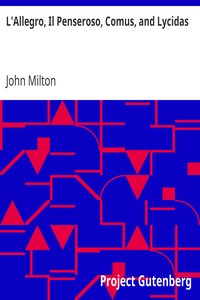
L'Allegro, Il Penseroso, Comus, and Lycidas by John Milton
This isn't a novel, but a collection of four distinct poems that show a young John Milton flexing his poetic muscles before he wrote his epic masterpiece.
The Story
The first two poems, 'L'Allegro' and 'Il Penseroso,' are companion pieces. 'L'Allegro' (The Happy Man) is an invitation to joy. It chases away gloom and spends a day in the English countryside, reveling in the sounds of larks, the sight of sunlit meadows, and the simple fun of country folk. 'Il Penseroso' (The Thoughtful Man) does the opposite. It dismisses shallow mirth and embraces the melancholy beauty of night, lonely walks under the moon, and the deep peace found in a lamp-lit study. They aren't really arguing; they're exploring two sides of a full life.
'Comus' is a different beast—a 'masque' or a kind of play with music. A Lady gets lost in a dark wood and is captured by Comus, a villain who uses magic and smooth talk to try to break her strong will. Her two brothers set out to find her, guided by a protective spirit. It's a battle of pure temptation against unwavering virtue.
'Lycidas' is a poem born from grief. Milton wrote it after a friend drowned at sea. Using the framework of a pastoral elegy (shepherds mourning a lost companion), it moves from sorrow to rage against the unfairness of death, before finding a fragile, Christian hope.
Why You Should Read It
I love this book because it shows a human Milton. We see his conflict between loving the world and needing to retreat from it, a feeling I think anyone who's ever been overstimulated can understand. The language is rich and musical—you can almost hear the lark's song in 'L'Allegro' and feel the quiet of the midnight study in 'Il Penseroso.' 'Comus' is a fantastic, almost fairy-tale-like story about standing your ground, and 'Lycidas' contains some of the most raw and beautiful lines about loss I've ever read. It's not difficult poetry; it's sensory and emotional.
Final Verdict
Perfect for readers curious about classic poetry but intimidated by long epics. It's also great for anyone who enjoys nature writing, explores big questions about happiness and contemplation, or just wants to read some stunningly beautiful English. If you've only known Milton as the 'Paradise Lost' guy, this collection is the perfect, and much more accessible, introduction to his genius.
This digital edition is based on a public domain text. Use this text in your own projects freely.
Carol Moore
2 months agoWithout a doubt, the clarity of the writing makes this accessible. I will read more from this author.
David Gonzalez
1 year agoBased on the summary, I decided to read it and the author's voice is distinct and makes complex topics easy to digest. Worth every second.
David Hernandez
1 month agoUsed this for my thesis, incredibly useful.
Betty Torres
1 year agoVery interesting perspective.

Michael Thomas
1 year agoGood quality content.