1

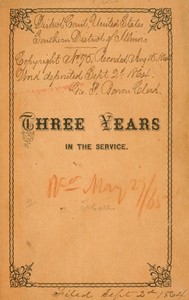
Three Years in the Service A Record of the Doings of the 11th Reg. Missouri Vols. — Text and Context
(0 User reviews)
597
Project Gutenberg
2015
Not confirmed
United States -- History -- Civil War, 1861-1865 -- Personal narratives; United States -- History -- Civil War, 1861-1865 -- Regimental histories; United States. Army. Missouri Infantry Regiment, 11th (1861-1866); Missouri -- History -- Civil War, 1861-1865 -- Regimental histories
Readers of public-domain and historical texts
Project Gutenberg digital edition
en
Edition facts
Words
33,863
Reading time
148 min
Text sections
3
The catalog record for Three Years in the Service A Record of the Doings of the 11th Reg. Missouri Vols. — Text and Context provides practical reading context through 33,863 words, 2 hr 28 min estimated reading time, and 3 detected text sections.
The text analysis averages about 21.4 words per sentence, while the detected sections provide another way to judge how the source is divided.
Project Gutenberg metadata also associates the work with “United States -- History -- Civil War, 1861-1865 -- Personal narratives,” connecting these edition facts with the source record’s subject description.
Source:
Project Gutenberg record #48822
A private's firsthand account of the 11th Missouri Volunteers during the Civil War, marked by plain-spoken narration, abrupt shifts between mundane camp life and violent action, and a distinctive voice that records both personal hardship and collective military maneuvers without embellishment.
Editorial Edition Score
4.5/5
★★★★★
★★★★★
Calculated from edition completeness, EPUB availability, text structure and catalogue metadata. Not a user rating.
How this score is calculated
- Description quality20 pts
- Title & short description10 pts
- Source metadata20 pts
- Text length15 pts
- Chapters / structure15 pts
- EPUB file integrity20 pts
Total of 100 points, scaled to a 2.5-5.0 range. Editions with an empty description or a missing EPUB file are not scored.
Edition quality
Public-domain source text
Read the source text
The source text is kept in the dedicated reader, separate from this catalogue record and its commentary.
D. McCall, a private in Company B of the 11th Missouri Volunteers, writes with a directness that sets his memoir apart from more polished regimental histories. His opening sentence—'Being anxious to serve my country, I walked to Springfield, Illinois, a distance of twenty-five miles'—establishes a plain, factual tone that persists throughout. McCall rarely pauses for reflection; instead, he moves quickly from enlistment to travel, from drilling to combat, often compressing weeks into a single paragraph. Yet within this brisk narrative, specific details emerge: the dusty streets of St. Louis, the straw and plank beds at Marine Hospital, the 'impetuous valor' of a cavalry charge. These observations, grounded in the sensory experience of a soldier, give the account its authenticity.
A Private's Plain Voice
McCall writes in a straightforward, unadorned style that reflects his status as a private soldier. He does not attempt literary flourishes; his sentences are short, declarative, and often begin with simple temporal markers: 'After staying here for a few hours,' 'At daylight next morning,' 'Order was then given.' This plainness is not a limitation but a deliberate choice that conveys the immediacy of camp life and combat. When he describes the 'sorrowful scenes at parting from friends,' he immediately undercuts the sentiment by noting that as a stranger to the company, he 'had no regrets at leaving.' Such blunt honesty characterizes his voice throughout. He records the mundane—washing in the river, eating with relish after a day without food—alongside the extraordinary, like the charge of the 5th Illinois Cavalry, where 'sabres glistening in the sun' momentarily breaks the matter-of-fact tone. McCall's language is that of an observer who reports what he sees without imposing a grand narrative, making the memoir a valuable document of a common soldier's perspective.
Abrupt Shifts in Pace and Attention
The narrative moves in sudden, unannounced shifts between slow, detailed accounts of daily routines and rapid, compressed descriptions of battle. For instance, McCall spends several paragraphs on the regiment's early days at Marine Hospital—drilling eight hours a day, struggling with inadequate provisions—but then dispatches the entire Battle of Shiloh (not excerpted here) in a few sentences. In the Yazoo expedition, he lingers on the destruction of towns and the heat that caused soldiers to die of sunstroke, yet the cavalry charge is summarized in a single, vivid sentence: 'They bore down on the rebels with sabres glistening in the sun, rushing at full speed upon the enemy.' This uneven pacing is not a flaw but a reflection of a soldier's experience: long stretches of boredom punctuated by moments of intense, chaotic action. McCall's attention to detail also varies; he notes the height of cornstalks planted by order of Jefferson Davis, but gives no description of the enemy's faces or the sound of gunfire. His focus is on the physical environment and the movement of troops, not on the emotional or sensory chaos of battle.
Recurring Details of Landscape and Logistics
Throughout the excerpts, McCall repeatedly notes the physical conditions of marching and camping: the dust, the heat, the availability of water, the quality of rations. These details anchor the narrative in the material realities of a soldier's life. He observes that the streets of St. Louis were 'dusty, which made it quite disagreeable marching,' and later, on the Yazoo expedition, that the road was 'dry and dusty' and that 'no air stirring' made it 'almost impossible to proceed.' Such observations are not merely atmospheric; they explain the pace of movement and the toll on the men. McCall also pays close attention to logistics—the issuing of rations, the loading of boats, the order to draw two days' rations before a march. His account of the Yazoo expedition includes precise details about the composition of the force: 'three brigades of infantry, under command of Brig. Gen. Kimble; also several regiments of cavalry, with artillery.' This focus on the mechanics of military operations, combined with the personal perspective of a private, gives the memoir a unique dual viewpoint: the soldier who experiences the heat and dust, and the chronicler who records the order of battle.
Readers approaching McCall's memoir should expect a narrative that prioritizes fact over feeling, yet reveals character through its very plainness. The author's voice—unpolished, direct, occasionally wry—offers a rare glimpse into the mind of a Civil War private. Pay attention to what McCall chooses to describe in detail (the height of corn, the number of prisoners) and what he passes over quickly (the emotions of battle). These choices, as much as the events themselves, shape the record of the 11th Missouri's service.
There’s something about that private’s plain-spoken weariness in Three Years in the Service that lingers. When he pauses between battles to note the small, unglamorous acts of endurance, I think of those quiet records of persistence in Fruits of Toil in the London Missionary Society — Background and Themes. Different wars, different causes, yet the same unadorned human grit—just kept, barely mentioned, somehow unforgettable.
There are no reviews for this eBook.
There are no comments for this eBook.
Reader reflection
Your personal reading reflection
Build a private reading journal entry for this title.
Your progress
0
/
10
2
How much did you enjoy the reading experience?
3
Would you pass this book on to a friend?
4
What was the reading difficulty like?
5
Did you relate to its people, ideas, or situations?
6
How useful did the reading feel?
7
Did the story or argument move comfortably?
8
How understandable was the text?
9
In one sentence, what did you learn?
10