1

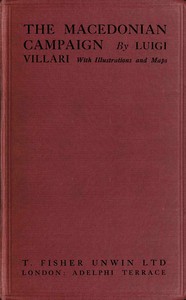
The Macedonian campaign — A Closer Reading
(0 User reviews)
84
Project Gutenberg
2023
Not confirmed
World War, 1914-1918 -- Campaigns -- Balkan Peninsula
Readers of public-domain and historical texts
Project Gutenberg digital edition
en
Edition facts
Words
96,792
Reading time
421 min
Text sections
31
For The Macedonian campaign — A Closer Reading, the stored edition analysis reports 96,792 words, 7 hr 1 min estimated reading time, and 31 detected text sections.
The text analysis averages about 26.9 words per sentence, while the detected sections provide another way to judge how the source is divided.
Project Gutenberg metadata also associates the work with “World War, 1914-1918 -- Campaigns -- Balkan Peninsula,” connecting these edition facts with the source record’s subject description.
Source:
Project Gutenberg record #72185
Luigi Villari's 1922 account of the Macedonian front in World War I, based on his service as Italian liaison officer, examines Allied operations, Greek political turmoil, and the interplay of national interests through a structured, scene-shifting narrative.
Editorial Edition Score
4.9/5
★★★★★
★★★★★
Calculated from edition completeness, EPUB availability, text structure and catalogue metadata. Not a user rating.
How this score is calculated
- Description quality20 pts
- Title & short description10 pts
- Source metadata20 pts
- Text length15 pts
- Chapters / structure15 pts
- EPUB file integrity20 pts
Total of 100 points, scaled to a 2.5-5.0 range. Editions with an empty description or a missing EPUB file are not scored.
Edition quality
Public-domain source text
Read the source text
The source text is kept in the dedicated reader, separate from this catalogue record and its commentary.
Luigi Villari, who served as Italian liaison officer with Allied commands in the East for two years, structures his 1922 account of the Macedonian campaign around a series of shifting scenes: from the Allied headquarters to Greek political crises, from troop movements to diplomatic maneuvering. The book opens with a prefatory note explaining that it was originally written in Italian with a focus on the Italian contingent, then adapted for an English audience by omitting some Italian details and adding general material. This dual origin shapes the work’s movement between close-up operational views and broader strategic commentary.
A Liaison Officer’s Vantage Point
Villari’s role as liaison officer gives the narrative a distinctive structural pattern: he moves between different Allied commands, collecting unpublished material and recording conversations with “the chief actors in the Balkan war drama.” The text repeatedly shifts from high-level policy discussions—such as the negotiations over Greek intervention—to on-the-ground observations. This alternating rhythm is not merely stylistic but reflects the author’s position as an intermediary. The reader is placed inside headquarters yet also given glimpses of the wider political landscape, as when Villari notes that “the insolent and petulant attitude of the Greek press intensified anti-Greek feeling in Italy.” Such shifts create a layered account where military events are constantly reframed by national perspectives.
Recurring Images of Political Turmoil
A recurring image in the excerpts is that of a fractured Greek state: the “National Defence Government” comes to an end, Greece is “once more united,” but the description emphasizes purges, deportations, and a population that “accepted the new régime without resistance, if without enthusiasm.” Villari returns to the theme of internal division, contrasting the Royalist upper class with the Venizelist minority. The language of cleansing—“to cleanse the State of Royalist officials”—and the enumeration of “trials and convictions for political offences” create a pattern of political violence that mirrors the military conflict. This imagery of internal fracture is set against the Allies’ need for a stable Greek ally, producing a tension that runs through the narrative.
Movement Between Fronts and Capitals
The structure of the book is marked by rapid movement between geographical and political arenas. Villari describes the Allied position in Macedonia, then shifts to Athens, then to the Italian and French home fronts. For instance, the discussion of Greek politics is immediately followed by an analysis of why “Britain and France, especially the latter, desired Greek intervention.” This back-and-forth is not merely chronological but thematic: the author juxtaposes the military stalemate in Macedonia with the diplomatic struggles in European capitals. The phrase “the Armée d’Orient might hold its own on its positions, but a new offensive could only be attempted with any hope of success if fresh reinforcements were forthcoming” captures this sense of a front that is both static and dependent on distant decisions.
The Italian Perspective as a Structural Lens
Villari repeatedly frames events through an Italian lens, noting that “in Italy, the Greek situation was never fully understood” and that Italian public opinion was shaped by specific grievances: the Dodecanese question, Albanian independence, and Greek occupations. This perspective gives the narrative a distinctive angle, as the author corrects what he sees as misconceptions in British and French accounts. The structure thus becomes a corrective: Villari moves from describing Allied actions to explaining why Italian views differed. The recurring phrase “Italians did not believe that Greek Imperialism had a sound basis” signals a pattern of national self-assertion within the broader Allied narrative. This structural choice makes the book not just a campaign history but a document of inter-Allied tensions.
Readers approaching Villari’s account should attend to the way he orchestrates shifts in scale and perspective: from the liaison officer’s notebook to the general staff’s map, from the streets of Athens to the trenches of Macedonia. The book rewards those who follow these movements closely, as they reveal the author’s method of building a campaign history from the inside out. The recurring images of political fracture and the persistent Italian viewpoint are not digressions but essential threads in a narrative that insists on the complexity of coalition warfare.
Some books sit with you like a conversation you weren’t ready to leave. That’s how I felt about Villari’s account of the Macedonian front—the way he lingers on small human moments within vast political turns. It reminded me, quietly, of The Sequel of Appomattox: A Chronicle of the Reunion of the States — Reading Companion, where the ache of stitching a country back together feels just as tender and unresolved.
There are no reviews for this eBook.
There are no comments for this eBook.
Reader reflection
What was your reading experience?
Capture what you thought, learned, and would like to remember.
Your progress
0
/
10
2
Did this book hold your interest?
3
Would you encourage someone else to read it?
4
How much effort did this book require?
5
Did you gain anything practical from the text?
6
How closely did the book connect with your experience?
7
Did the story or argument move comfortably?
8
Did the book deliver what you hoped for?
9
In one sentence, what did you learn?
10