1

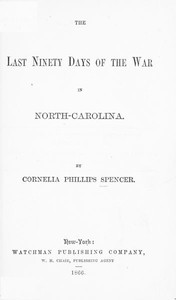
The Last Ninety Days of the War in North-Carolina — Reading Companion
(0 User reviews)
888
Project Gutenberg
2020
Not confirmed
United States -- History -- Civil War, 1861-1865 -- Campaigns; North Carolina -- History -- Civil War, 1861-1865
Readers of public-domain and historical texts
Project Gutenberg digital edition
en
Edition facts
Words
76,432
Reading time
333 min
Text sections
8
The Last Ninety Days of the War in North-Carolina — Reading Companion can be approached with a clearer sense of reading commitment from its source measurements: 76,432 words, 5 hr 33 min estimated reading time, and 8 detected text sections.
The text analysis averages about 26.2 words per sentence, while the detected sections provide another way to judge how the source is divided.
Project Gutenberg metadata also associates the work with “United States -- History -- Civil War, 1861-1865 -- Campaigns,” connecting these edition facts with the source record’s subject description.
Source:
Project Gutenberg record #62332
Cornelia Phillips Spencer's 1866 account of the final months of the Civil War in North Carolina, blending personal observation, legal argument, and historical contrast, with a distinctive narrative voice that shifts between intimate anecdote and formal polemic.
Editorial Edition Score
4.7/5
★★★★★
★★★★★
Calculated from edition completeness, EPUB availability, text structure and catalogue metadata. Not a user rating.
How this score is calculated
- Description quality20 pts
- Title & short description10 pts
- Source metadata20 pts
- Text length15 pts
- Chapters / structure15 pts
- EPUB file integrity20 pts
Total of 100 points, scaled to a 2.5-5.0 range. Editions with an empty description or a missing EPUB file are not scored.
Edition quality
Public-domain source text
Read the source text
The source text is kept in the dedicated reader, separate from this catalogue record and its commentary.
Spencer opens her narrative not with a battle but with a problem of evidence: the difficulty of writing history when participants are dead or silent. The preface frames the work as a series of newspaper sketches that grew unexpectedly, and the dedication to David L. Swain signals the author's reliance on insider testimony. The voice is that of a partisan observer who insists on truthfulness while openly defending North Carolina's leaders. This tension—between claimed objectivity and declared loyalty—shapes every page.
A Voice That Shifts Between Intimacy and Indignation
Spencer's prose moves abruptly from warm personal recollection to cold legal citation. In the same paragraph she may quote Lord Cornwallis's order-book and then describe a young lady's interview with the British general. The effect is disorienting: the reader is asked to hold both a grandmother's memory and a treatise on international law in mind at once. This hybrid voice reflects the author's dual role as a woman of letters and a polemicist. She addresses the reader as a confidante, using phrases like "one of those little coïncidences which brighten life," then pivots to a dry analysis of Halleck's authority versus Sherman's theory. The shifts are not accidental; they mimic the way war itself mixes the intimate and the institutional.
The Pace of Collapse: From Legal Argument to Silent Streets
The narrative accelerates markedly in the final chapters. Early sections move slowly, piling up quotations from Xenophon, Kent, and Bishop Atkinson to establish the laws of war. But as Sherman approaches Raleigh, the prose becomes cinematic: flames rising above the station-house, doors shut, window-blinds closed, "the same death-like silence." Spencer describes the city "with folded hands and drooping head" in a single, held breath. The change in pace is not merely stylistic; it enacts the suddenness of Confederate collapse. Where earlier she had time for legal digression, now she can only record the absence of life. The reader feels the acceleration as a kind of vertigo.
Recurring Contrasts: Cornwallis as a Mirror for Sherman
Spencer returns obsessively to the parallel between Cornwallis's campaign in the Carolinas and Sherman's march. She juxtaposes their routes, their treatment of civilians, their foraging practices. The comparison is not neutral: Cornwallis, she argues, followed the laws of war; Sherman violated them. But the device also serves a narrative purpose. By holding up a British general from eighty years earlier, Spencer creates a fixed point against which the chaos of 1865 can be measured. The reader learns to expect the contrast, and its repetition builds a rhythm. Each new chapter risks feeling like another variation on the same theme, yet the accumulating detail—a young lady's interview with Cornwallis, her grandson's treatment by Sherman's men—gives the pattern emotional weight.
Readers should attend to the way Spencer handles time. She compresses ninety days into a narrative that feels both breathless and digressive, and the tension between those impulses is the book's real subject. The legal arguments may seem dated, but the voice—intimate, indignant, and precise—remains striking. Approach the text as a document of how one woman tried to fix the meaning of defeat while the smoke was still rising.
I keep thinking about Spencer’s quiet rage, how she held grief and argument together like two hands clasped. It reminded me of another wartime voice, Britain at Bay — Text and Context, which carries that same weight of watching your world narrow. There’s something tender about witnessing a person reason with their own despair.
There are no reviews for this eBook.
There are no comments for this eBook.
Reader reflection
What did you think of this book?
Answer a few questions and save a private reflection on this device.
Your progress
0
/
10
2
Did this book hold your interest?
3
Would you encourage someone else to read it?
4
How much effort did this book require?
5
Was the book what you thought it would be?
6
Do you expect to return to this book?
7
What did you think about the pace?
8
How understandable was the text?
9
Which lesson or insight stayed with you?
10