1

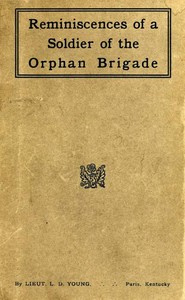
Reminiscences of a Soldier of the Orphan Brigade — Story, Setting & Ideas
(0 User reviews)
834
Project Gutenberg
2015
Not confirmed
United States -- History -- Civil War, 1861-1865 -- Personal narratives, Confederate; Confederate States of America. Army. Kentucky Brigade, 1st; Young, Lot D., 1842-; United States -- History -- Civil War, 1861-1865 -- Regimental histories -- Kentucky
Readers of public-domain and historical texts
Project Gutenberg digital edition
en
Edition facts
Words
34,114
Reading time
149 min
Text sections
4
The source record for Reminiscences of a Soldier of the Orphan Brigade — Story, Setting & Ideas measures this digital text at 34,114 words, 2 hr 29 min estimated reading time, and 4 detected text sections.
The text analysis averages about 28.2 words per sentence, while the detected sections provide another way to judge how the source is divided.
Project Gutenberg metadata also associates the work with “United States -- History -- Civil War, 1861-1865 -- Personal narratives, Confederate,” connecting these edition facts with the source record’s subject description.
Source:
Project Gutenberg record #50483
Lot D. Young's memoir of the Orphan Brigade, a Kentucky Confederate unit, recounts battles like Shiloh and Murfreesboro through vivid, ground-level observations. The narrative shifts between wartime action and postwar visits to battlefields, blending personal recollection with detailed terrain descriptions.
Editorial Edition Score
4.5/5
★★★★★
★★★★★
Calculated from edition completeness, EPUB availability, text structure and catalogue metadata. Not a user rating.
How this score is calculated
- Description quality20 pts
- Title & short description10 pts
- Source metadata20 pts
- Text length15 pts
- Chapters / structure15 pts
- EPUB file integrity20 pts
Total of 100 points, scaled to a 2.5-5.0 range. Editions with an empty description or a missing EPUB file are not scored.
Edition quality
Public-domain source text
Read the source text
The source text is kept in the dedicated reader, separate from this catalogue record and its commentary.
Lot D. Young, a lieutenant in the First Kentucky Brigade—known as the Orphan Brigade because its men were cut off from their home state—wrote this memoir decades after the Civil War. The opening pages include a dedicatory note to those who wore gray and a poem by a Union officer, Professor N. S. Shaler, which traces the brigade's arc from 1861 to 1865. Young's account is not a continuous history but a series of episodes, each anchored to a specific battle or location.
The excerpts show that Young often revisits battlefields years later, walking the ground with local guides. This dual perspective—the soldier's memory and the veteran's return—shapes the narrative. Readers should expect detailed descriptions of terrain, troop movements, and moments of intense personal reaction, rather than a broad strategic overview.
A Memoir Built on Return Visits
Young does not write from a single chronological vantage point. The excerpts reveal that he composed his recollections after traveling back to key sites, such as the Murfreesboro battlefield, where he walked the ground with Captain Mitchell and a young friend. This method gives the narrative a layered quality: the reader sees both the battle as it happened and the later effort to reconstruct it. Young notes that the picket fence at McFadden's ford “looks just as it did then, but of course has been rebuilt,” a small detail that underscores the gap between memory and present reality.
The structure of the book follows this pattern. Chapters are titled by battle names—Shiloh, Vicksburg, Murfreesboro, Lookout Mountain—but within each, Young moves between past action and present reflection. For instance, his account of the charge at Murfreesboro includes precise geography (the “narrow sag or depression” leading to the ford) and the emotional weight of revisiting where his captain fell. This technique makes the memoir as much about the act of remembering as about the events themselves.
Vivid, Ground-Level Descriptions of Combat
Young's prose is most striking when he describes the physical experience of battle. In the Murfreesboro excerpt, he writes of the “fifty-eight pieces of artillery” on the bluff that “wrought such dreadful havoc” on Breckinridge's men. He does not stay at a general's level; instead, he follows the path of the charge, noting where the Fourth Kentucky struck Beatty's line and where the Sixth Kentucky, led by “Old Joe” Lewis, made its assault. Lewis is described as an “incarnate demon of war,” a phrase that captures Young's intense, almost mythic view of his commanders.
Young also records sensory details: the sound of minnie balls beating “a funeral dirge” on enemy drums piled by a fence, the sight of a captain's last glance. These moments are not embellished with later reflection; they are presented as fixed images, “grimly and immovably fixed in my mind.” The reader gets a sense of how certain scenes seared themselves into Young's memory, and how he struggles to convey their impact—he writes that giving expression to his feelings at his captain's fall is “impossible.”
The Orphan Brigade's Identity and Loss
The brigade's nickname, “Orphan,” is explained in the opening poem by Professor Shaler, a Union officer who nonetheless praises the unit. The poem traces the brigade's dwindling numbers: “Five thousand strong” in 1861, “the half are yet here” after Shiloh, “shorn to a thousand” by 1863, and “scarce twelve score” by 1864. Young's prose echoes this sense of loss. At Murfreesboro, he notes that many of “our dear boys” were “compelled to halt and die to no purpose whatever.”
Young does not dwell on the larger meaning of the war; his focus is on the men he fought beside. The dedication “To Those Who Wore the Gray and to Their Children and Children's Children” signals that the memoir is intended for a specific audience—fellow veterans and their descendants. This inward focus means that readers unfamiliar with the Orphan Brigade's history will need to infer context from the battle narratives. Young assumes knowledge of names like Breckinridge, Beatty, and Rosecrans, and of the brigade's reputation.
A Guide to Reading Young's Terrain Descriptions
Young's battlefield tours are dense with place names and directional phrases: “the road to McFadden's ford,” “the crest of the ridge (now a cotton patch),” “the North slope of the ridge.” These passages can be difficult to follow without a map, but they reward careful reading. Young is not merely listing locations; he is recreating the experience of moving through the landscape under fire. The “narrow sag or depression” that offered the only protection from the artillery becomes a key tactical feature.
Readers may find it helpful to sketch the movements described, or to consult a historical map of the battle. Young's method is to walk the reader step by step, as he did with his companions. The payoff is a visceral sense of the ground—the slope, the fence, the river crossing—that shaped the battle's outcome. This attention to terrain is one of the memoir's strengths, setting it apart from more abstract accounts.
Young's Reminiscences is best approached as a series of connected vignettes rather than a continuous narrative. The excerpts suggest that the book rewards readers who take the time to visualize the ground and follow the troop movements. Young's voice is direct and personal, often more concerned with the men he fought beside than with the war's larger causes. For those interested in the Orphan Brigade's specific experience, this memoir offers a rare, ground-level perspective.
I’ve often lingered over Lot Young’s memoir, how he maps a battlefield with the same quiet reverence he later gives his ghosts. That patient, wary eye—watchful for what changes and what stays—finds a strange echo in an older pamphlet on revolution. Both men knew how easily a crowd becomes a storm, and how long the ground remembers. Bolshevism: A Curse & Danger to the Workers — Text and Context sits beside it now, a whispered conversation across a century.
There are no reviews for this eBook.
There are no comments for this eBook.
Reader reflection
Your personal reading reflection
Build a private reading journal entry for this title.
Your progress
0
/
10
2
How much did you enjoy the reading experience?
3
Would you pass this book on to a friend?
4
How demanding did the text feel?
5
How much did the book move you?
6
Did you gain anything practical from the text?
7
Would a second reading be valuable?
8
How personally connected did you feel to the book?
9
In one sentence, what did you learn?
10