1

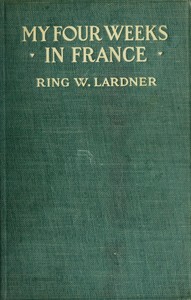
My four weeks in France — Text and Context
(0 User reviews)
80
Project Gutenberg
2024
Not confirmed
World War, 1914-1918 -- Personal narratives
Readers of public-domain and historical texts
Project Gutenberg digital edition
en
Edition facts
Words
35,357
Reading time
154 min
Text sections
13
My four weeks in France — Text and Context can be approached with a clearer sense of reading commitment from its source measurements: 35,357 words, 2 hr 34 min estimated reading time, and 13 detected text sections.
The text analysis averages about 14.3 words per sentence, while the detected sections provide another way to judge how the source is divided.
Project Gutenberg metadata also associates the work with “World War, 1914-1918 -- Personal narratives,” connecting these edition facts with the source record’s subject description.
Source:
Project Gutenberg record #73059
Ring Lardner's 1918 memoir recounts his four weeks as a war correspondent in France during World War I, blending self-deprecating humor with observations on military bureaucracy, language barriers, and the absurdities of war reporting.
Editorial Edition Score
4.8/5
★★★★★
★★★★★
Calculated from edition completeness, EPUB availability, text structure and catalogue metadata. Not a user rating.
How this score is calculated
- Description quality20 pts
- Title & short description10 pts
- Source metadata20 pts
- Text length15 pts
- Chapters / structure15 pts
- EPUB file integrity20 pts
Total of 100 points, scaled to a 2.5-5.0 range. Editions with an empty description or a missing EPUB file are not scored.
Edition quality
Public-domain source text
Read the source text
The source text is kept in the dedicated reader, separate from this catalogue record and its commentary.
Ring Lardner opens his account of four weeks in France with a comic negotiation: a gentleman from Connecticut proposes he become a war correspondent, despite Lardner's protest that he knows nothing about war. The reply—that this has frequently been proved irrelevant—sets the tone for a narrative that treats the machinery of war with irreverent wit. The diary format, beginning July 18, 1918, tracks his journey from a Lake Michigan port through bureaucratic hurdles: a French consulate demanding autographed photos, a steamship agent who notes the ship has never been sunk. Lardner's deadpan delivery turns each obstacle into a punchline, establishing a voice that will observe the war's strangeness without false heroics.
The Breeches and the Puttees
Lardner's physical discomfort becomes a running joke. After acquiring a uniform, he writes that his knees were "fairly groaning to be free of the breeches." He resists advice to wear them all day, preferring to keep them neat for the next day. The puttees—cloth leggings—require help from fellow correspondent Mr. Gibbons, and Lardner oversleeps, needing assistance again. He notes that regular correspondents and British officers "are obliged to wear canes," adding dryly that the wonder is they don't use crutches. This focus on the mundane indignities of military dress undercuts any romantic notion of the correspondent's life, grounding the narrative in physical reality.
A Feast of Languages
On a train to the British front, Lardner finds standing room among Australian and Canadian soldiers returning from leave. He describes himself as "a glutton for languages," and the day becomes a feast of six kinds: Australian, Canadian, British, French, Chinese, and Harvard. He claims to have acquired "an almost perfect understanding" of the first three and Harvard, which he studied back home. French and Chinese prove more difficult; French, he says, is pronounced "as if a goat were saying it." This playful taxonomy of dialects reveals Lardner's ear for speech and his ability to find humor in cultural collision, even as he stands among men returning from the front.
The Red-Headed Captain's Tale
An Australian captain shares a story: his best pal, a small man, captured a boche lieutenant over six feet tall. When asked if he spoke English, the German shook his head; asked if he spoke French, he lost his temper and, in English, insulted the entire continent of Australia. The captain's little pal then marched him off, making him remove his helmet as punishment. Lardner presents this anecdote without commentary, letting the absurdity speak for itself. The story encapsulates the war's strange codes—where a prisoner's linguistic deception is punished by a hat—and Lardner's method of letting small incidents reveal larger truths about conflict and character.
Candlelight and Château Rules
Writing by candlelight in a château once occupied by a queen, Lardner notes the household rule: downstairs lights are doused at eleven. After that, one can sit in darkness or retreat upstairs to "bask in the brilliant rays of a candle." He admits he might be sleepy enough for bed but fears forgetting something if he postpones the day's record. This moment captures the diarist's compulsion—the need to set down events before they fade. The contrast between the grand setting and the meager light, between the queen's former room and the correspondent's makeshift office, underscores the war's transformation of spaces and routines.
Lardner's narrative never reaches the front in a dramatic sense; instead, it circles the edges of combat, recording the logistics, language lessons, and minor humiliations that fill a correspondent's days. Readers should approach this memoir as a comedy of manners set against a backdrop of global conflict, where the most telling details are often the smallest. The diary form rewards attention to dates and locations, which mark a journey that is as much about the absurdities of travel as about war.
I remember when My Four Weeks in France found its shelf-mate here, that old war correspondent chuckling at the muddle of languages, the proud nonsense of armies. It put me in mind of The Sequel of Appomattox: A Chronicle of the Reunion of the States — Reading Companion, for both whisper how hard it is to mend what war unravels—one in laughter, one in quiet stitching. They sit closer now.
There are no reviews for this eBook.
There are no comments for this eBook.
Reader reflection
What was your reading experience?
Capture what you thought, learned, and would like to remember.
Your progress
0
/
10
2
Was reading this book enjoyable?
3
How likely are you to recommend this book?
4
What was the reading difficulty like?
5
How useful were the ideas in this book?
6
Which part made the strongest impression?
7
How closely did the book connect with your experience?
8
Did the book offer a fresh perspective?
9
Which lesson or insight stayed with you?
10