1

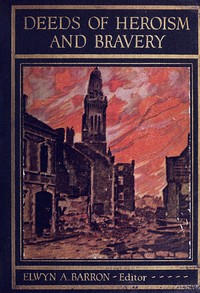
Deeds of heroism and bravery — Inside the Classic
(0 User reviews)
135
Project Gutenberg
2025
Not confirmed
World War, 1914-1918 -- Personal narratives
Readers of public-domain and historical texts
Project Gutenberg digital edition
en
Edition facts
Words
209,940
Reading time
913 min
Text sections
110
Deeds of heroism and bravery — Inside the Classic can be approached with a clearer sense of reading commitment from its source measurements: 209,940 words, 15 hr 13 min estimated reading time, and 110 detected text sections.
The text analysis averages about 19.7 words per sentence, while the detected sections provide another way to judge how the source is divided.
Project Gutenberg metadata also associates the work with “World War, 1914-1918 -- Personal narratives,” connecting these edition facts with the source record’s subject description.
Source:
Project Gutenberg record #75487
This editorial note examines how the opening, middle, and later excerpts of 'Deeds of Heroism and Bravery' guide a first reading, highlighting the work's structure as a collection of short, episodic narratives from World War I, its focus on individual acts of courage, and the editorial framing that shapes reader expectations.
Editorial Edition Score
4.9/5
★★★★★
★★★★★
Calculated from edition completeness, EPUB availability, text structure and catalogue metadata. Not a user rating.
How this score is calculated
- Description quality20 pts
- Title & short description10 pts
- Source metadata20 pts
- Text length15 pts
- Chapters / structure15 pts
- EPUB file integrity20 pts
Total of 100 points, scaled to a 2.5-5.0 range. Editions with an empty description or a missing EPUB file are not scored.
Edition quality
Public-domain source text
Read the source text
The source text is kept in the dedicated reader, separate from this catalogue record and its commentary.
The table of contents immediately signals that this is not a continuous history but a mosaic of short pieces—over a hundred in total—grouped into sections such as “Field and Trench Ordeals,” “Women Who Dared,” “Adventure in the Air,” and “Sea and Sub-Sea Stories.” The editor, Elwyn Barron, has assembled accounts that range from a few paragraphs to several pages, each headed by a vivid title like “He Jests at Scars” or “The Nemesis of Flame.” The introduction by Rupert Hughes and the inclusion of poems (e.g., “The Gunboat,” “Edith Cavell”) suggest an aim to blend reportage with tribute.
A first reader encountering the opening excerpts will notice the variety of voices: some pieces are first-person narratives (“Tank Man Talks”), others are third-person profiles (“Colonel Freyberg, V. C.”). The prose is often dramatic, with a preference for action verbs and direct speech. The excerpts do not provide a single overarching argument but rather a series of vignettes that collectively illustrate courage under fire.
The Opening: Establishing the Frame
The first section, “Field and Trench Ordeals,” sets the tone with titles that promise both action and irony. “And a Few Marines” and “Forward Lancers” suggest military units, while “He Jests at Scars” hints at gallows humor. The opening pages do not offer a preface explaining the selection criteria; instead, the reader is plunged directly into stories. The excerpt from “Worthy Citation” introduces Captain E. W. Zinn, a veteran of the French Foreign Legion and Lafayette Escadrille, who assigned young American aviators to squadrons. This piece explicitly questions what counts as heroism, arguing that it includes “self-dedication to an altruistic service” even when no official decoration follows. Such meta-commentary appears only occasionally, but it signals that the collection is not merely celebratory—it also interrogates the very concept of heroism.
The Middle: Shifts in Scale and Subject
As the reader moves into the middle sections, the range of subjects expands dramatically. “Women Who Dared” includes the well-known story of Edith Cavell alongside less famous figures like “A Picardy Heroine” and “Girls of the Battalion.” The air combat section features legendary aces such as Guynemer, whose fate is described in detail: his final flight on September 11, 1918, his disappearance, and the French belief that he was “taken up into his native heaven.” The prose here becomes almost mythic, quoting a marble plaque inscription. Yet the same section also includes “Worthy Citation,” which returns to the theme of unrecognized service. This juxtaposition—between celebrated heroes and unsung ones—creates a tension that the editor does not resolve, leaving readers to weigh different kinds of bravery.
Later Excerpts: The Air War and Its Toll
The later excerpts concentrate heavily on aviation, with stories like “One of the Great ‘Aces’” and “The Lafayette Escadrille.” The account of Guynemer’s decline is particularly striking: after his fiftieth victory, he became “nervous and irritable,” lost his “instincts of the air,” and ignored pleas to rest. The narrative emphasizes his pride—he feared accusations of cowardice if he stopped fighting. This psychological detail is rare in the collection, which mostly focuses on external action. The editor includes contradictory German reports about Guynemer’s death, then notes the French belief in his immortality. Such ambiguity is unusual for a book titled Deeds of Heroism and Bravery; it suggests that the editor allowed complexity to stand, perhaps trusting readers to draw their own conclusions about the costs of heroism.
Structural Patterns: Episodic Yet Thematic
Across the excerpts, a clear structural pattern emerges: each piece is self-contained, often beginning with a striking title and ending with a poignant detail or a reflection. The editor groups stories by domain (land, sea, air, women, spies) but does not impose a single narrative arc. This makes the book suitable for browsing rather than linear reading. The inclusion of poems at section ends (e.g., “I Have a Rendezvous with Death”) adds a lyrical counterpoint to the prose. Notably, the excerpts do not include any maps, diagrams, or indexes; the reader relies solely on the table of contents and the stories themselves. For a first-time reader, the best approach may be to sample a few pieces from different sections to gauge the range of tones—from the matter-of-fact “The Bald Facts” to the elegiac “The Flight into the Unknown.”
First-time readers should treat this collection as a series of snapshots rather than a continuous history. The editor’s hand is light, allowing the stories to speak for themselves, but the selection itself is a statement: heroism takes many forms, from the decorated ace to the anonymous captain assigning planes. The excerpts suggest that the book rewards dipping in and out, letting individual accounts resonate. Pay attention to the titles—they often contain clues to the story’s tone. And note the moments when the narrative pauses to question its own subject, as in “Worthy Citation”; those are the places where the collection reveals its deeper curiosity about what courage means.
This collection’s episodic courage reminds me of my grandfather’s war diary—short, stark entries he never expanded. I felt that same hush reading The Truth about the Titanic — Reading Companion, where survival’s quiet moments lingered like his penciled margin notes. Both books hold grief at arm’s length, letting small acts speak for themselves.
There are no reviews for this eBook.
There are no comments for this eBook.
Reader reflection
Before you leave, reflect on the book
Use these questions to collect your thoughts before moving on.
Your progress
0
/
10
2
Was reading this book enjoyable?
3
Is this a title you would suggest to others?
4
How much effort did this book require?
5
How closely did the book connect with your experience?
6
Could you apply anything you learned?
7
Which element worked best for you?
8
How would you describe its reading pace?
9
What changed or sharpened your thinking?
10